Origin and Synonyms
Common names: Cichlasoma hybr. “Red Parrot”, Red Parrot, Blood Parrot Cichlid, Parrot Cichlid.
Natural habitat: This species doesn’t exist in nature and never could, for the simple reason that it’s a human creation. This hybrid was artificially produced in Taiwan in the late 1980s, with first mentions dating back to 1986.
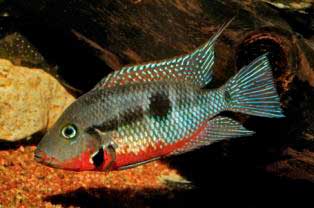
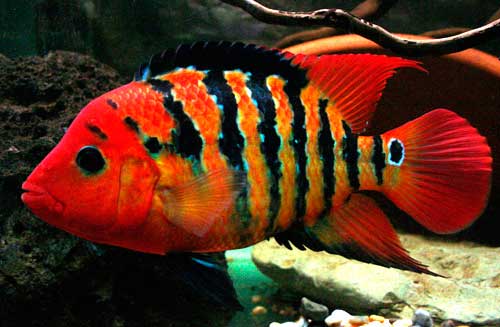
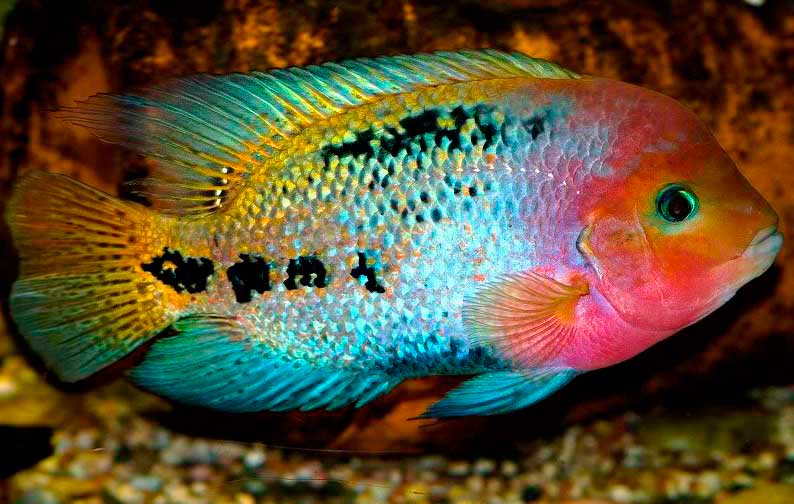
The information about which species formed the basis for obtaining this hybrid remains a commercial secret to this day — the only certainty is that various South American cichlid species were involved. Among the most probable ancestors are Amphilophus citrinellus (Midas cichlid), Paraneetroplus synspilus (Redhead cichlid), Amphilophus labiatus (Red Devil cichlid), and Cichlasoma severum. It’s believed that descendants of Paraneetroplus synspilus and Amphilophus citrinellus were used in developing the Blood Parrot.
I should note that the exact species used in creating this fish likely remain a trade secret. We may still not know precisely which species were involved or how many. We can only take Taiwanese breeders at their word that this is a three-way hybrid and that genetic engineering wasn’t employed in its creation.
Physical Description
Blood Parrots can reach 30 centimeters in length, though aquarium specimens are typically more modest at around 20 centimeters. Juveniles are often sold at just 5-7 centimeters, but mature into 15-18 cm adults.
Key Characteristics
| Parameter | Value |
|---|---|
| Maximum size | 20-30 cm |
| Body shape | Rounded, barrel-shaped |
| Head feature | Beak-like, parrot-resembling |
| Primary coloration | Red, orange |
| Lifespan | 10-15 years |
| Temperament | Peaceful, playful |
| Care difficulty | Moderate |
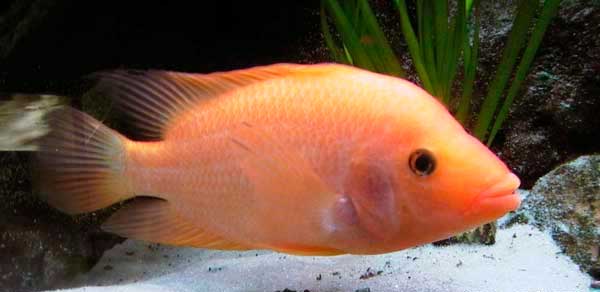
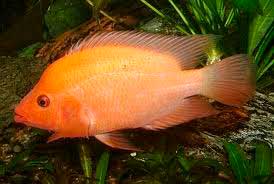
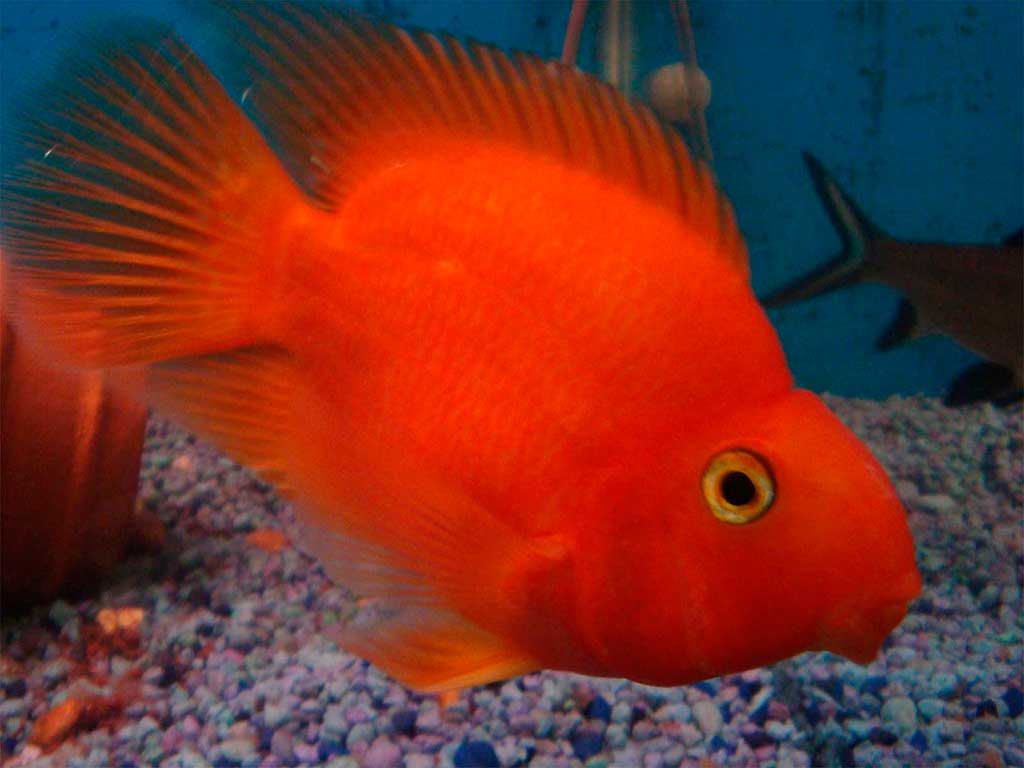
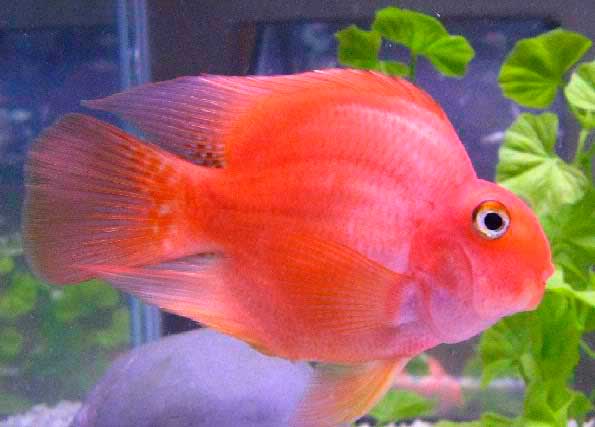
The defining features of this species lie in its body shape and coloration. The cichlid’s head resembles a parrot’s — hence the trade name Blood Parrot. “Red” because red is the most stable color, though with improper nutrition even red fades, transforming into orange.
Two enormous eyes dominate the head. The head terminates in a relatively small mouth frozen in a characteristic “smile”. Parrots have rounded bodies, beak-shaped heads, and mouths shaped like inverted triangles. Sometimes variations appear with half-tails, giving the fish the outline of “swimming hearts”.
Color Varieties
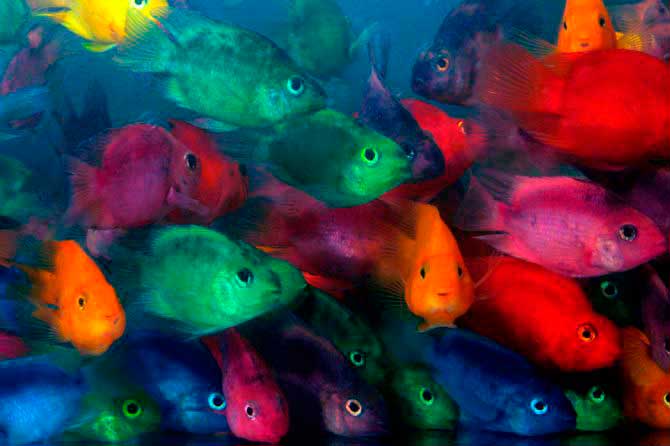
Fish are typically colored bright orange but can also be red, yellow, brown, or gray. Natural colors for parrots are red, orange, yellow, and white. However, shops stock parrots in various colors: green, blue, purple, pink.
Some breeders dye fish to obtain other colors like green, blue, or purple, which shortens their lifespan. While it’s normal for aquatic organisms to acquire pigment colors from consumed food, green, blue, and purple Blood Parrots result from adding synthetic pigments to feed. How harmless these dyes are for the fish themselves and their tankmates remains anyone’s guess.
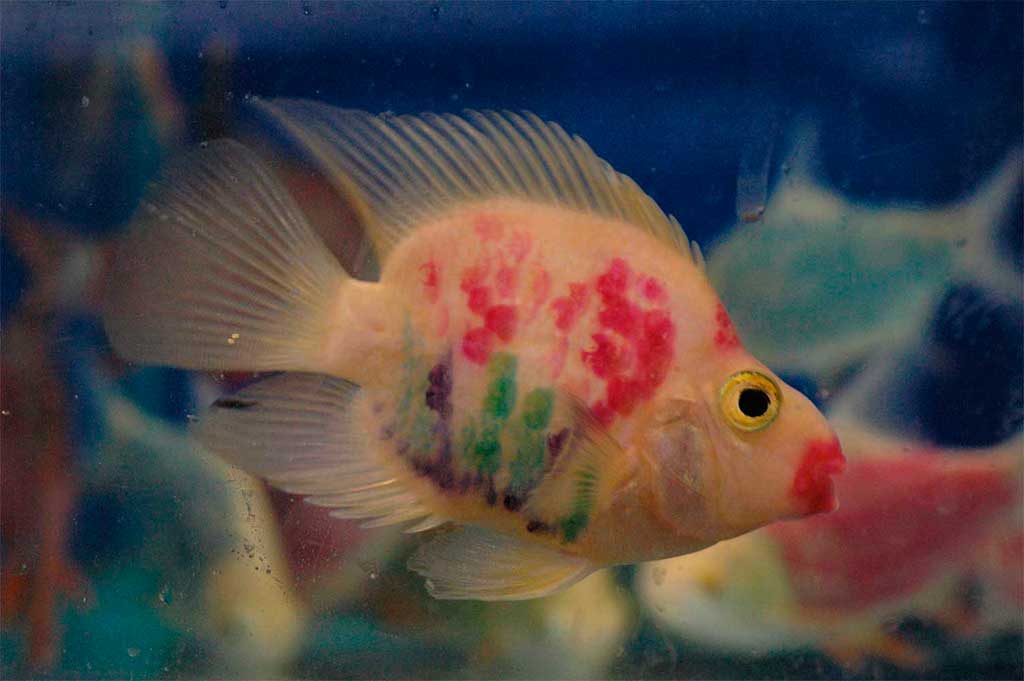
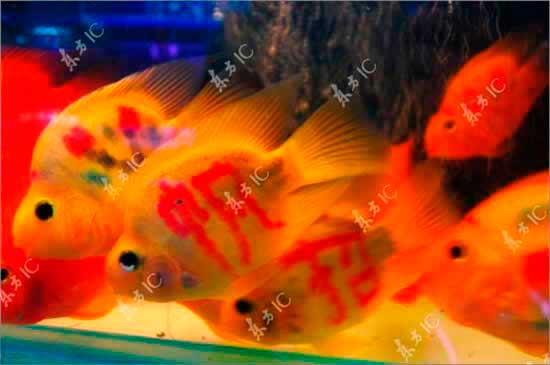
Tattoos and characters: If you encounter a cichlid with characters or drawings on its body, understand that the fish underwent a procedure similar to tattooing. Such designs are applied much like human tattoos. Perhaps the fish are somehow anesthetized during this, though I personally doubt it very much. And all for money — such fish cost more.
In my experience, every time you purchase such a tattooed fish, you’re investing money in this business, condemning another fish to a procedure it would hardly consent to if anyone asked. I don’t recommend acquiring dyed or tattooed fish — this supports cruel practices and shortens the fish’s lifespan.
Sex Differences
Distinguishing males from females outside the spawning period is practically impossible. During spawning attempts, they differ by the anal papilla, like all cichlids. In males it resembles a cone; in females, a truncated pyramid or pear shape.
Blood Parrot Cichlid Care
Like many hybrids, Blood Parrots exhibit excellent health, appetite, and sterility. Overall, care won’t cause problems for experienced aquarists.
Tank Volume
Tank volume should be at least 150 liters for a pair. With smaller housing, your favorites simply won’t reach maximum size. Don’t misunderstand me — don’t cram a school of 10 individuals into a small aquarium. The minimum tank size for one adult parrot is 200 liters; for a group of three fish, a tank from 280 liters is recommended.
While my attitude toward this human creation has a somewhat critical tinge, the fish is nevertheless decorative and certainly not guilty of what humans did to it. After all, most goldfish breeds were also developed by breeders, and their artistry undoubtedly deserves respect. The Blood Parrot Cichlid should be kept as a work of breeder artistry, which it is.
Substrate and Decoration
Substrate for the aquarium: small pebbles or gravel work well. Despite all human efforts, Blood Parrots retained the breeding instinct and in futile spawning attempts will dig up all substrate in the aquarium, uprooting plants, creating pits and mounds on the bottom.
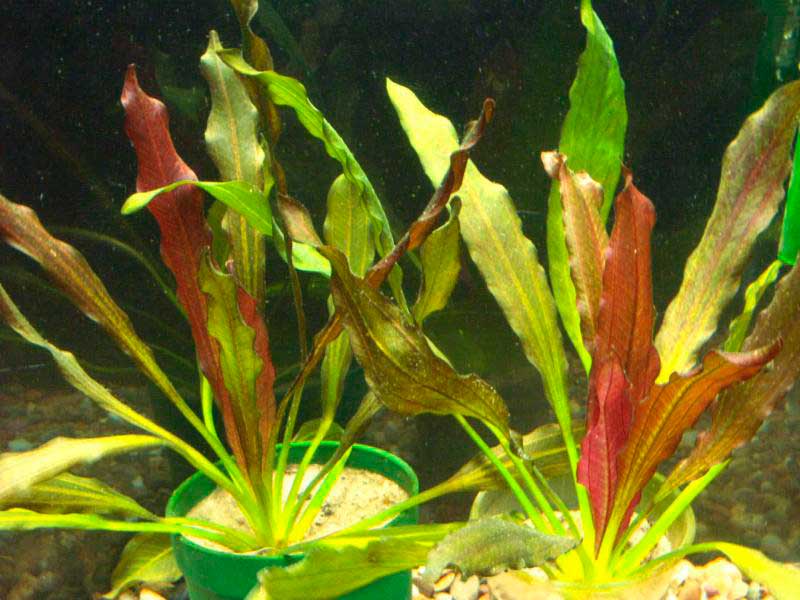
The bottom can also be decorated with driftwood and plant roots. From large stones, construct rocks, ravines, and grottoes. Considering the above, plants should be potted, camouflaging them with large stones these restless fish can’t move. Choose mechanically tough plants with hard leaves.
Water Parameters for Blood Parrot Cichlid
| Parameter | Value |
|---|---|
| Temperature | 22-27°C |
| pH | 6.5-7.8 |
| Hardness | 8-20°dH |
| Water changes | 20-30% weekly |
| Aeration | Required |
| Filtration | Powerful |
For optimal health, maintain water temperature between 22-28°C and pH level from 6.0 to 8.0, with neutral pH around 7.0 being ideal. Some recommendations suggest not raising temperature above 24°C. This somewhat suppresses the breeding instinct, which in turn prevents the need for substrate excavation and protects your plants.
Bright lighting is recommended, though I think this is more to emphasize the animal’s bright coloration. The cichlid itself likely doesn’t need bright lighting.
Aeration and Filtration
These active creatures produce much waste, so changing 20-30% of aquarium water weekly is recommended. Water aeration and filtration are necessary. Moreover, they must be quite intensive, but this still isn’t sufficient for your pets’ normal well-being. You must additionally change 30% water weekly for fresh dechlorinated water. Some authors indicate that changing 10% daily is desirable. I think 30% weekly will be quite sufficient.
Proper aquarium technical equipment ensures stable water parameters and fish health.
Blood Parrot Cichlid Compatibility
Parrot cichlids aren’t malicious by nature and can coexist with other species. Due to their deformed mouth, they can’t cause serious harm to other fish and are rather shy, but acclimate well in community tanks. You should only consider that when forming pairs they “get carried away playing” and may corner anyone.
The best neighbors for parrot fish are similarly-sized cichlids. In a species tank, it’s better to keep a small school of five or more fish. In a community tank, select fish of comparable size.
Suitable Tankmates:
- Oscars
- Acaras
- Severums
- Convict cichlids
- Flowerhorns (with caution)
- Large barbs
- Labeos
- Geophagus
Incompatible Neighbors:
Small fish like guppies, neons, or Danio rerio may be eaten. From calmer discus or angelfish, Blood Parrots may snatch food right from their mouths. Avoid very small fish because your parrot will attempt to swallow them.
Feeding Blood Parrot Cichlid
Humans didn’t deprive Blood Parrots of appetite. They’ll happily eat everything fitting in their mouth. Moreover, food quality is far from first priority. They may quite readily eat yesterday’s dinner leftovers in the morning and create a merry life for owners who were too lazy to remove uneaten food in the evening.
Recommended Foods
You can feed the same foods most cichlids prefer:
- Bloodworms
- Earthworms
- Tubifex
- Grindal worms
- Insects
- Shrimp
- Raw fish pieces
Foods high in carotenoids help preserve red coloration. Plant supplements rich in carotenoids are necessary.
But if you want to preserve as long as possible the color with which you purchased your little parrot, you must regularly supplement with branded foods to which manufacturers add specific pigment. Bright red coloration is maintained through specialized feeds containing large quantities of carotenoids — when fed ordinary foods, the fish restore orange coloration.
I recommend using quality dry cichlid foods with added carotenoids, alternating them with frozen foods. This provides fish complete nutrition and maintains color brightness.
Lifespan
With proper care, these fish can live 10 to 15 years. With correct care and maintenance, the parrot cichlid can delight owners with affection and quite amusing behavior for up to 10 years. In my experience, key longevity factors are stable water parameters, quality nutrition, and a spacious aquarium.
Breeding
I won’t describe breeding in detail in this article. The fact is that, like most hybrid life forms, male Blood Parrot aquarium fish are sterile. Females may be fertile and capable of crossbreeding with other cichlids, for example with convict cichlids.
There may even be viable offspring, but it won’t be Blood Parrots. Cichlasoma hybr. “Red Parrot” can only be obtained by reproducing the technology used at Asian fish farms.
However, if you want to experiment, breeding conditions for these fish don’t differ greatly from most cichlids. Fish perform courtship displays, dig nests in substrate, females lay eggs, but the reproduction process usually ends there.
Behavior and Temperament
They learn to recognize their owners and swim to the front glass to greet them. Generally the fish is very friendly. It shows more interest in humans than other cichlids, tracking every hand movement hoping for another tasty morsel.
So you can confidently purchase a Blood Parrot Cichlid if you like it. And to avoid conscience pangs, choose specifically red or orange varieties without any “naturally appearing” patterns. I don’t recommend acquiring dyed or tattooed fish — this supports cruel practices and shortens fish lifespan.
Article updated: 2026-09-16