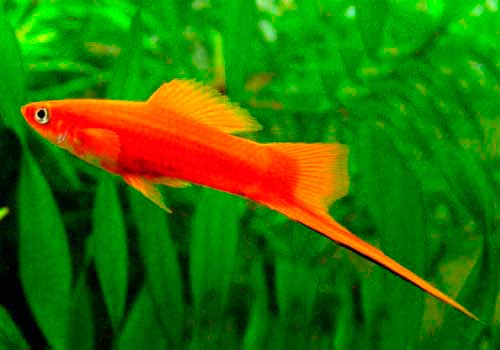
The swordtail (Xiphophorus hellerii) is a popular aquarium fish belonging to the Poeciliidae family. In natural habitats, these fish are found in both fast-flowing mountain rivers and calm lakes, ponds, and marshes along the Atlantic coast of Central America. In my experience, swordtails are particularly interesting because European aquariums house far more of these fish than their native waters, where they’ve become relatively rare in the wild.
Swordtail Appearance and Description
Swordtails are attractive fish that add vibrant color to any aquarium. Nature has given them a distinctive appearance that’s hard to miss. Males measure 7-8 cm (excluding the sword), while females reach 10-12 cm. Their bodies are slender and elongated with compressed sides. The upturned mouth indicates they naturally feed from the water’s surface.
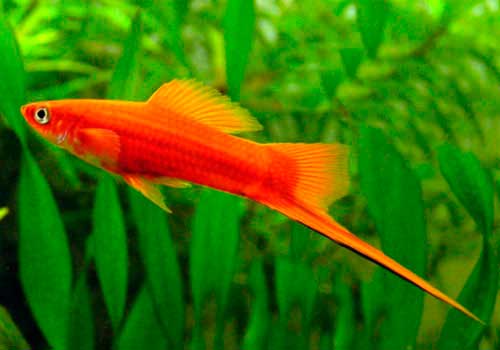
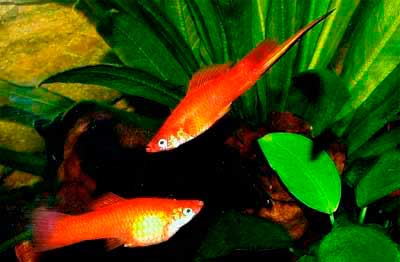
Males are easily distinguished from females by the elongated lower ray of the caudal fin, resembling a sword—the feature that gives these fish their common name. Wild swordtails display greenish coloration with several longitudinal stripes of varying width along the body. The male’s sword features dark edging in different shades: yellow-orange, green, or red. Females have more subdued coloring in pale tones.
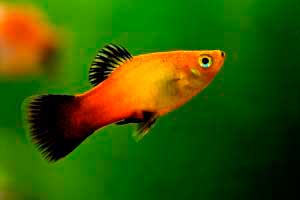
Over 30 decorative varieties of swordtails exist today: red, black, calico, tiger, Berlin, koi, and others. Most aquarium swordtails are hybrids created by crossbreeding with platies.
Tank Requirements for Swordtails
These active, social fish need a long, spacious aquarium—at least 50 liters for a single pair, though groups of several fish require 80-100 liters minimum. Water depth should reach approximately 30 cm. The tank should include shaded areas with plants like vallisneria, elodea, cabomba, and riccia where fish can retreat, while maintaining open swimming space in the front and middle sections.
Swordtails are extremely active and can jump out of the water, so a tank lid or cover glass is essential. In my experience, this is one of the most common reasons beginners lose their fish.
Water Parameters for Swordtails
| Parameter | Value |
|---|---|
| Temperature | 20-26°C |
| Hardness (dH) | 8-25° |
| pH | 7.0-8.0 |
| Water changes | 20-30% weekly |
| Filtration | Required |
| Aeration | Required |
Water parameters must remain stable without sudden fluctuations. I recommend adding a small amount of salt (1 tablespoon per 10 liters) for disease prevention, though this isn’t strictly necessary.
Weekly water changes of 20-30% of tank volume are essential, with replacement water 1-2 degrees warmer than tank water. Quality filtration and aeration are important for maintaining healthy conditions.
Feeding Swordtails
Swordtails are omnivorous and naturally consume plants, small crustaceans, insects, and worms. In aquariums, they readily accept daphnia, cyclops, bloodworms, tubifex, as well as plant-based and frozen foods. Quality dry foods in flake or pellet form work well.
It’s important to include plant matter in their diet—lettuce leaves, spinach, or spirulina-based foods. In my experience, swordtails enthusiastically graze on algae in the aquarium, which helps maintain cleanliness. For more on balanced nutrition, see our guide on fish feeding.
Remove any uneaten food after 5 minutes, as it will sink and pollute the water. I recommend feeding twice daily in small portions.
Compatibility with Other Fish
Swordtails are peaceful fish that coexist well with others of similar temperament and size. They’re compatible with mollies, platies, tetras, catfish, and rainbowfish. For breeding information on similar livebearers, check out our mollies breeding guide.
However, they may occasionally harass slow-moving or very small fish. I don’t recommend housing them with goldfish or long-finned varieties, as swordtails may nip their fins. Male swordtails sometimes show aggression toward each other, especially in crowded tanks. They’re generally considered unpretentious aquarium fish, making them suitable for beginners.
Breeding Swordtails
Swordtails are livebearers. In groups, maintain a female-to-male ratio of 3:1 to prevent dominant males from harassing weaker ones. Sexual maturity occurs at 6-8 months.
Fertilization is internal, with gestation lasting 2-3 weeks or longer depending on feeding and the female’s condition. Pregnant females ready to give birth are easily recognized by their swollen belly and dark spot near the anal fin.
Birth typically occurs in the morning. Fry are well-formed and immediately seek cover in floating plants, resulting in high survival rates. You can leave the female in the main tank if sufficient food is available and dense plant cover exists for fry to hide.
Brood sizes range from 20 to 50 fry, with larger females producing 100 or more. Swordtails readily hybridize with platies in aquarium conditions when fry are raised together.
Lifespan and Health
Under good conditions, swordtails live 3-5 years, with some individuals reaching 5-6 years. In my observations, lifespan directly correlates with stable water parameters and quality feeding.
Swordtails are quite hardy but susceptible to typical aquarium fish diseases. Ich (white spot disease) is most common, appearing as white coating on fins and scales. Prevention involves maintaining tank cleanliness, stable water parameters, and avoiding sudden temperature drops.
Regular tank maintenance, proper feeding, and timely water changes ensure your swordtails’ health. Isolate sick fish immediately and begin treatment when disease symptoms appear.
Article updated: 2026-07-30