Introduction
The convict cichlid was first described in 1867 and has since won numerous admirers among aquarists worldwide. This hardy, relatively peaceful fish with fascinating behavioral traits can be kept in medium-sized aquariums, making it an almost ideal choice for hobbyists looking to explore the remarkable world of cichlids.
Classification and Natural Range
Scientific Classification:
- Kingdom: Animalia
- Phylum: Chordata
- Class: Actinopterygii
- Order: Perciformes
- Family: Cichlidae
- Genus: Amatitlania
- Species: Amatitlania nigrofasciata
Note: Current classification follows the 2007 taxonomic revision.
Natural Habitat: Lakes Amatitlán and Atitlán in Guatemala; rivers and lakes throughout Guatemala, Nicaragua, Honduras, Costa Rica, and Panama.
Physical Description and Sexual Dimorphism

The convict cichlid has a relatively tall, laterally compressed, and moderately elongated body. In nature, males can reach 15 centimeters in length, while females are typically half that size. In aquarium conditions, fish rarely exceed 10-12 centimeters.
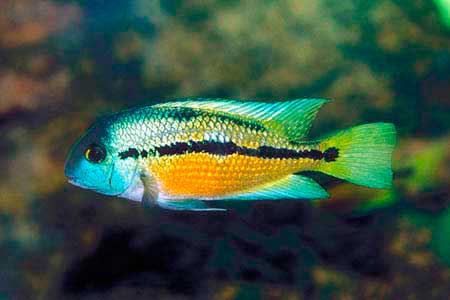
The body displays a gray-blue coloration with 8-9 distinctive black vertical bars that extend onto the dorsal and anal fins. Both dorsal and anal fins are broad and elongated, stretching nearly to the base of the caudal fin.
Sexual differences are quite pronounced. Males are one and a half to two times larger than females. Their dorsal and anal fins are broader with extended, pointed tips. Females ready to spawn develop a bright orange coloration on the posterior portion of their belly.
Color Variations
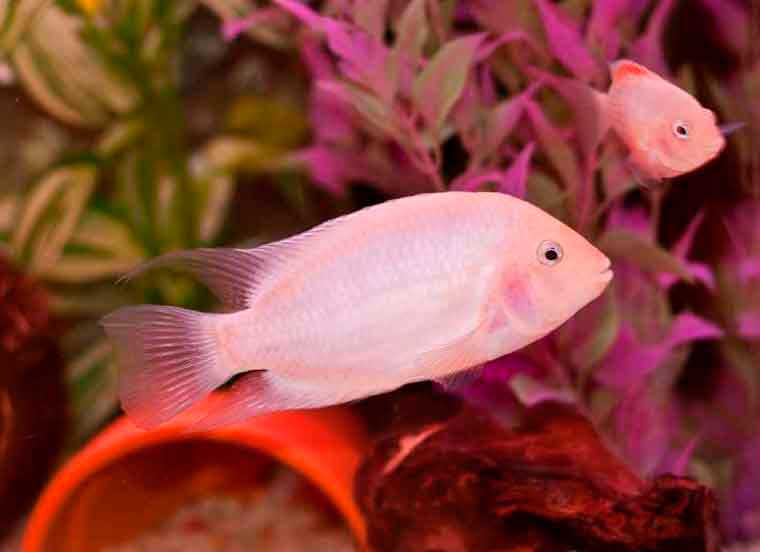
Besides the classic gray-blue form, aquarists favor the pink (albino) form of the convict cichlid. These fish have light pink bodies with less contrasting bars but are identical to the standard form in temperament and care requirements. This variety is also known as the flamingo cichlid.
Care Parameters
| Parameter | Value |
|---|---|
| Minimum Tank Size | 100 liters per pair |
| Temperature | 24-28°C (75-82°F) |
| pH | 6.8-8.0 |
| Hardness (dH) | 8-30° |
| Lifespan | 8-10 years |
| Sexual Maturity | 7-10 months |
| Care Difficulty | Easy |
Aquarium Setup
In my experience, keeping convict cichlids is straightforward, making them excellent for beginners.
Tank Size
While not the largest cichlids, their territorial behavior requires careful consideration when selecting tank size. For a breeding pair, I recommend at least 100 liters. These fish spawn almost year-round, and during breeding periods they vigorously defend their nest and surrounding territory.
For community tanks with other cichlids, choose even larger volumes—200 liters or more. The bottom should feature numerous hiding spots: artificial rocks, caves, and robust rooted plants. Proper space zoning helps reduce aggression.

Substrate and Decorations
Use granite gravel or small pebbles (3-5 mm) for substrate. Like most cichlids, convict cichlids enjoy rearranging the bottom to their liking. Sand creates excessive cloudiness and should be avoided. Large stones prevent fish from customizing their environment and deprive you of observing their construction activities.
Use larger rocks to create territorial divisions, build grottos, and establish shelters. The more creativity you apply when preparing hiding spots, the less likely your fish will uproot plants to excavate cozy burrows.
Plants
Like all cichlids, convict cichlids are landscape architects. Uprooting plants to dig comfortable burrows and pile decorative mounds of gravel nearby ranks among their favorite activities.
Select plants with strong root systems and tough leaves. Some larger Echinodorus and Cryptocoryne species work well. Fast-growing species prove even better: Vallisneria spiralis and free-floating Elodea canadensis. Dense stands of these plants help divide the aquarium into distinct territories, promoting relative peace.
Water Parameters
Convict cichlids are undemanding. Dechlorinated tap water heated to 24-28°C suits them well. Water hardness can range from 8 to 30°dH. Neutral pH with slight fluctuations between 6.8-8.0 is ideal.
Lighting
These fish have no special lighting requirements. Fluorescent lamps totaling 0.3-0.5 watts per liter provide adequate illumination. Side or front lighting enhances their appearance in reflected light, though implementing such setups proves technically more challenging than overhead lighting. The fish accept overhead lighting without issue, and it’s more natural for them.
Aeration and Filtration
Aeration and filtration are desirable but not mandatory for a single pair in a 100-liter tank. These become necessary in community setups—parameters depend on overall stocking levels. Low-flow aeration and filtration become advisable when your fish produce fry.
Compatibility with Other Fish
“Crowded but content” doesn’t apply to cichlids. Community tanks must provide adequate space to minimize territorial conflicts.
In my experience, convict cichlids show considerably less aggression toward species from different genera and families than many other cichlids. Swordtails, schools of cherry barbs, neon tetras, or zebra danios can safely cohabit with them. However, relatively slow-moving veiltails with flowing fins should not be housed with active convict cichlids.

Among other cichlids, good tankmates include Bolivian rams and other relatively peaceful species of comparable size. Remember that aggression increases significantly during spawning, when they’ll defend their territory against any neighbors.
Feeding
Convict cichlids are omnivorous. Traditional foods include bloodworms, tubifex, and scraped meat. Approximately one-third of their diet must consist of plant matter: blanched oatmeal, chopped lettuce or cabbage leaves, boiled zucchini pieces, and carrots.
I recommend quality dry cichlid foods in granule or flake form as dietary staples, supplemented with frozen and plant-based foods 2-3 times weekly. Feed adults once or twice daily with portions consumed within 2-3 minutes.
Interesting note: if you place your hand underwater, these striped defenders will attempt to attack it—not to feed, but from territorial instincts, protecting their domain from an unusual “aggressor.”
Breeding
Breeding convict cichlids presents no difficulties. Fish can spawn in community tanks, though considering their increased aggression during this period, a separate 50-liter breeding tank proves better, especially if the main tank is modest in size.
Pair Formation
These fish are facultatively monogamous and form pairs from early juvenile stages. Purchasing a group of young fish and allowing natural partner selection works best. Convict cichlids reach sexual maturity at 7-10 months.
Spawning Process
Spawning occurs year-round, sometimes with successive spawns following short intervals for offspring care. Monthly, you may discover small “nurseries” in favored locations where attentive parents escort their brood on outings.
Eggs are deposited on the thoroughly cleaned floor of a small cave. A sideways-placed clay pot or submerged teacup positioned away from the viewing glass serves this purpose well.
Parental Care

Larvae emerge after approximately two to three days. Still helpless, they receive continued parental care: parents fan them with fins like hand fans and carry them in their mouths for excursions. While youngsters “enjoy fresh air” under one parent’s supervision, the other cleans debris from the cave.
Watching parents tend their offspring captivates for hours—this ranks among the species’ greatest breeding attractions. Soon the yolk sac disappears and fry begin swimming freely. Start feeding them at this point.
Raising Fry
Fry are quite large, so starter foods include newly hatched Artemia nauplii and cyclops. As they grow, offer finely chopped tubifex and quality dry fry foods. With proper feeding and regular water changes, juveniles grow rapidly.
A single female can produce 300-500 eggs per spawn. Given their high fecundity and frequent spawning, breed these fish in reasonable quantities.
Conclusion
Convict cichlids have been kept in aquariums for decades. Despite numerous other cichlid species becoming available, this species remains among the most interesting and popular due to its hardiness, engaging behavior, and breeding simplicity. For beginning aquarists wanting to explore the cichlid world, it’s nearly the perfect choice.
Article updated: 2026-11-02