Introduction
The Salvini Cichlid was first described by Günther in 1862, yet it only found its way into home aquariums toward the end of the last century. This species captivates hobbyists with its vibrant coloration and the remarkable intelligence characteristic of cichlids. However, keeping this fish comes with challenges related to its territorial nature. Once you navigate these difficulties, the rewards are well worth the effort.
Classification and Taxonomy
| Parameter | Value |
|---|---|
| Kingdom | Animalia |
| Phylum | Chordata |
| Class | Actinopterygii |
| Order | Perciformes |
| Family | Cichlidae |
| Genus | Trichromis |
| Species | Trichromis salvini |
Important note: Since 2015, this species has been officially reclassified into the genus Trichromis based on phylogenetic research, though the former name Cichlasoma salvini remains widely used in literature and the aquarium trade.
Common names: Salvini Cichlid, Tricolor Cichlid, Yellow-belly Cichlid
Synonyms: Cichlasoma salvini, Cichlasoma tenue, Astronotus salvini, Heros trigramma, Nandopsis salvini, Parapetenia salvini
Natural Habitat

The Salvini Cichlid inhabits shallow, slow-moving waters in the eastern portion of Central America, ranging from southern Mexico to Guatemala. In the wild, these fish prefer areas along riverbanks with ample cover provided by driftwood and rocks.
Physical Description
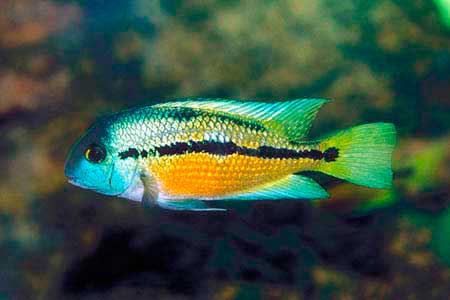
This species displays an elongated, laterally compressed body. The base coloration ranges from yellow-orange to occasionally reddish tones. A prominent series of large, anthracite-colored spots runs along the midline of the body. Just above this row, another longitudinal stripe composed of similar but smaller spots extends from head to tail.
In aquarium conditions, Salvini Cichlids typically reach 15-16 centimeters in length and can live up to 13 years. Wild specimens occasionally grow larger, reaching up to 22 centimeters.
The head is substantial with large eyes featuring distinctive red irises. The lips are thick and fleshy. Gill covers display an attractive pattern of emerald-green dots and stripes. Sexual maturity occurs at 10-12 months of age. The species is facultatively monogamous, with pairs typically forming when fish reach approximately six months old.
Sexual Dimorphism
Distinguishing males from females is straightforward. Males grow larger and develop a pronounced nuchal hump on the forehead. Females possess two additional black markings: a single spot located approximately midway along the dorsal fin, and paired spots on the gill covers below the midline, closer to the belly. These spots create the appearance of additional false eyespots.
Aquarium Care Requirements
Keeping Salvini Cichlids presents moderate challenges. The primary difficulty stems from their strong-willed temperament, a trait common among most cichlids.
Tank Size
A minimum volume of 100 liters is required for a single pair. Larger aquariums allow for keeping additional specimens, calculating approximately 30-40 liters per individual fish.
Substrate
Virtually any substrate works, though granite gravel or small pebbles are preferable. A substrate depth of about eight centimeters provides sufficient anchoring for robust-rooted plants. The bottom should feature numerous hiding places constructed from large stones, rock formations, and driftwood. These decorations not only create an appealing underwater landscape but also provide essential refuges for fish seeking solitude or escaping from more aggressive tankmates.
Aquatic Plants

Select flora with strong root systems and hardy leaves. Delicate plants can be placed in the brightly lit central area of the aquarium, which Salvini Cichlids, being shade-preferring fish, tend to avoid. Many aquarists report that plants situated in open areas without overhead cover from driftwood, flat rocks, or floating vegetation remain undisturbed. These cichlids typically claim territories beneath some form of overhead shelter.
Compared to other cichlids, Salvini Cichlids treat plants relatively gently. Therefore, even species like Amazon sword plants can succeed in open areas. Suitable plant choices include various Cryptocoryne species, Myriophyllum, Vallisneria, and Elodea. I recommend Elodea for its rapid growth rate—while it may be considered invasive in natural ecosystems, in cichlid aquariums it provides excellent natural cover without requiring artificial substitutes.
Water Parameters
Optimal water conditions include: temperature 24-26°C, pH 6.5-8.0, and total hardness 8-15 dGH. These fish tolerate a range of water chemistry—hardness from 5 to 20 dGH and pH from 7.0 to 8.5 are acceptable.
Temperature requirements are more stringent, necessitating the 24-26°C range. Therefore, equipping the aquarium with a reliable heater and thermostat is advisable.
Lighting
As mentioned, Salvini Cichlids prefer territories sheltered from intense overhead illumination. Consequently, excessive lighting should be avoided. Fluorescent lighting at approximately 0.3 watts per liter provides sufficient illumination to encourage your fish to venture from hiding while allowing you to appreciate their beauty.
Filtration and Aeration
Both aeration and filtration are essential, particularly in community setups. Water must remain clean with adequate dissolved oxygen levels. A powerful external canister filter is recommended.
Compatibility with Other Fish
Salvini Cichlid compatibility presents challenges. This species exhibits territorial behavior even under normal conditions. During spawning periods, the aquarium effectively divides into two zones: one exclusive territory for the breeding pair, and the remaining space for all other inhabitants.

Interestingly, they show greater tolerance toward species from different families—such as barbs, swordtails, and platies—than toward relatives of their own species, genus, or family. Conspecifics and close relatives face aggression both during and between breeding periods. In my experience, the most successful tankmates are reasonably active, hardy species capable of occupying the upper and middle water layers.
Feeding
As with most predatory species, live foods are preferred. Salvini Cichlids readily consume bloodworms, glassworms, tubifex, shrimp, snails, and small feeder fish. They also accept high-quality prepared foods formulated for cichlids.
Breeding Salvini Cichlids
These fish may spawn in community aquariums, though all tankmates will be confined to areas distant from the breeding territory. Additionally, Salvini Cichlids are not only aggressive but also easily stressed. Disturbances can result in loss of offspring, potentially triggering conflicts between the pair that may end badly for the female and subsequently the male, who may decline without his partner.
Therefore, establishing a dedicated breeding tank is advisable. A 100-liter aquarium with numerous bottom shelters serves this purpose well. If the pair selects an exposed location, provide overhead cover—an arch of large stones, substantial driftwood, or floating plants like Riccia or duckweed.
Until suitable cover exists, spawning may be delayed even when other conditions are met. Additional spawning triggers include frequent large water changes and raising temperature by 2-4°C.
Spawning and Fry Development

When conditions meet their standards, the pair deposits up to 500 eggs on a smooth surface—typically a flat stone or piece of driftwood. Incubation lasts approximately 5 days. The resulting larvae initially subsist on their yolk sacs before transitioning to independent feeding.
Salvini Cichlid fry are relatively large. They can forage among plant growth if any remains after parental nest preparation. Supplement their diet with newly hatched brine shrimp nauplii, and within approximately one week they can consume finely chopped tubifex.
Temperature Requirements for Fry
Maintain water temperature at no less than 26°C in the grow-out aquarium—lower temperatures may prove fatal to developing fry.
Salvini Cichlids provide extended parental care. Without stress, fry need not be removed. However, if you observe unusual behavior in the parents—particularly aggression toward each other or attempts to act on such aggression—immediately remove the adults from the breeding tank. Separate them from each other using a divider or separate containers until tensions subside.
Conclusion
The Salvini Cichlid represents a stunning member of the cichlid family. Due to behavioral complexities, maintaining this species in aquariums proved challenging for many years, and it remains relatively uncommon in the hobby today.
This fish demands consistent attention, yet its fascinating behavioral patterns and magnificent coloration make Trichromis salvini a prized addition to any cichlid enthusiast’s collection. Its moderate size allows for housing in tanks suitable for most modern living spaces.
Beginners captivated by these cichlids should prepare to address various challenges. Those who successfully navigate these obstacles invariably conclude the effort was worthwhile.
Article updated: 2026-10-22