Why Round Aquariums Are Surrounded by Myths
A round aquarium is a striking interior element that evokes warm memories for many people. However, in recent years, the internet has been flooded with articles claiming catastrophic harm from the spherical shape for fish and other inhabitants. In my experience, most of these claims are either exaggerated or simply untrue.
Many of these publications look like marketing tactics — creating “shocking” content about a familiar object. Some authors mindlessly copy information from each other without fact-checking. Let’s examine the most common myths and the real characteristics of round aquariums.
Seven Popular Myths About Round Aquariums
Myth 1: Difficult to Find Equipment
Grain of truth: Yes, manufacturers produce filters, heaters, and lights primarily for rectangular tanks. But this is more a matter of convenience than fundamental impossibility.
Reality: Today, specialized equipment for round aquariums is available — hang-on filters, compact heaters, LED lights with rim mounting. I recommend looking for models that come fully equipped. Additionally, experienced aquarists can adapt some devices themselves. When choosing your setup, it’s wise to consider aquarium equipment options regardless of tank shape.
Myth 2: Inconvenient Maintenance
Grain of truth: The curved walls can indeed accumulate algae quickly, and cleaning them with standard scrapers isn’t always comfortable.
Reality: Algae grow rapidly not because of the vessel’s shape, but due to disrupted biological balance — excess light, organics, or unbalanced plant nutrition. If you maintain proper water parameters, the problem is minimal. Special magnetic scrapers and long-handled sponges exist for cleaning curved surfaces.
Yes, the outer surface collects dust faster than flat surfaces — this requires regular external wiping.

Myth 3: Image Distortion
Grain of truth: Wall curvature creates optical distortions.
Reality: In tanks of 20 liters or more, distortions are minimal, especially at the front wall closest to the observer. Fish appear almost natural. Objects near the back wall may distort slightly, creating an interesting surrealistic background that sometimes enhances the decorative effect. In my experience, this “flaw” often becomes an artistic advantage.
Myth 4: Excessive Water Pressure on Fish

Reality: This is a physically illiterate claim. According to Pascal’s law, liquid pressure at a given depth doesn’t depend on vessel shape — it’s determined only by the water column height. A fish at 20 cm depth experiences identical pressure in both round and rectangular aquariums of the same height. This myth fails elementary high school physics.
Myth 5: Amplified Vibrations and Fish Stress
Grain of truth: A solid glass vessel may indeed resonate more than framed or silicone-sealed constructions, where joints partially dampen vibrations.

Reality: Water itself effectively dampens sound waves. Whether this effect is critical for fish is debatable and unsupported by research. Following this logic, we’d have to declare eggshells harmful to chicks and astronaut helmets dangerous. Placing the aquarium away from constant noise sources (speakers, washing machines) addresses any potential issue.
Myth 6: Unreliable Construction
Reality: This claim contradicts physics. The spherical shape is one of the strongest constructions, evenly distributing load. Consider an egg: its shell withstands significant external pressure but cracks easily from inside. A round aquarium is less susceptible to internal stress than a rectangular glued tank with flat walls. With proper use (no impacts or sharp temperature changes), it can serve for decades. Tank safety depends primarily on manufacturing quality and operating conditions, not shape.
Myth 7: Too Small Volume
Grain of truth: Here I partially agree with critics. Modern glass sphere production technology limits available volume to about 50 liters at reasonable prices.
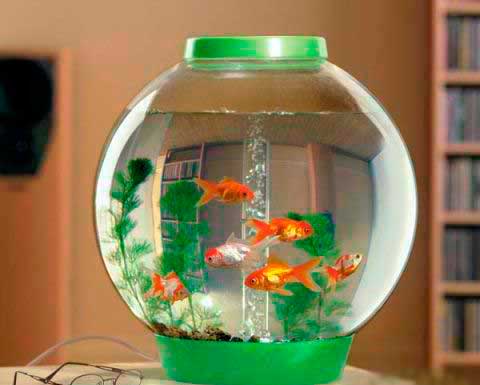
Reality: 50 liters is indeed insufficient for large fish, especially goldfish that marketers love depicting in round aquariums. That’s advertising’s main mistake. However, for properly selected species, this volume is adequate. I recommend stocking round aquariums with small schooling fish: guppies, Danio rerio, neon tetras, small barbs, microrasboras. For shrimp and snails, this volume works excellently.
The “Banned in the West” Argument
Some authors reference round aquarium bans in Western countries. Even if true, the fact itself proves little. Sanitary standards differ between countries for many reasons — not always scientifically justified.
For example, permissible concentration limits for certain substances under Soviet norms were orders of magnitude stricter than Western ones. This didn’t make Soviet norms automatically correct and Western ones harmful, or vice versa. Appealing to “it’s banned there” without analyzing ban reasons is a weak argument.
Real Disadvantages of Round Aquariums
Let’s be honest: the spherical shape has objective downsides:
- Limited equipment selection — though it exists, the range is smaller than for rectangular models
- More difficult to clean internal walls — requires special tools
- Small maximum volume — rarely exceeds 50 liters
- Rapid dust accumulation on external surface
- Fish species limitations — unsuitable for large and territorial species
- Harder to create complex aquascapes — shape doesn’t lend itself to multi-level compositions
Advantages and Proper Use

Yet round aquariums possess unique benefits:
Decorative appeal: Properly designed, with good lighting and crystal-clear water, it becomes a true interior decoration.
All-around viewing: Unlike rectangular models, a sphere can be placed in the room’s center or on a round table.
Compactness: Occupies little space while offering decent volume.
| Parameter | Recommendation |
|---|---|
| Volume | 20 liters minimum |
| Fish | Small schooling: guppies, danios, neons, Celestial Pearl Danio |
| Plants | Undemanding: Anubias nana, Java moss, Marsilea |
| Equipment | Hang-on filter, compact heater, LED light |
| Water changes | 20-30% weekly |
| Stocking | Maximum 1 cm fish per 2 liters water |
What Round Aquariums Are Good For
Not suitable for:

- Species tanks with large fish
- Biotope compositions
- Grow-out tanks
- Fish breeding
- Goldfish (despite advertising!)
Excellent for:
- Decorative interior accent
- Keeping small schooling fish
- Shrimp tanks
- Minimalist plant compositions
- Beginners (with proper inhabitant selection)
My Conclusion
In my experience, the alleged harmfulness of round aquariums to their inhabitants is greatly exaggerated or simply fabricated. Yes, they require more careful equipment and inhabitant selection. Yes, they’re slightly more challenging to maintain. But with the right approach — proper fish selection, regular care, quality lighting — a round aquarium is not only safe for its residents but can become a stunning home decoration.
If your goal is giving your interior special character, creating a mesmerizing aquatic world visible from all sides, then a properly designed round aquarium surpasses any rectangle, even one occupying half the room. The key is approaching its setup consciously, understanding its features and limitations. Proper aquarium cabinet placement and ensuring adequate filtration will help you succeed with this unique tank shape.
Article updated: 2026-10-01