Why You Need a Specialized Aquarium Stand
An aquarium stand serves multiple critical functions simultaneously. It provides a reliable foundation for your tank, offers storage space for equipment and supplies, and conceals aquarium technical equipment from view. While a small 5-10 gallon tank can sit on a desk, any aquarium of 15 gallons or larger requires a specialized stand.
In my experience, the biggest mistake beginners make is underestimating the weight of a filled tank. One gallon of water weighs approximately 8.3 pounds, and you must add the weight of glass, substrate (which can double the water weight), decorations, and equipment. A 50-gallon aquarium creates a load of 550-650 pounds—equivalent to three or four adults standing in one spot. Regular furniture simply cannot handle this kind of concentrated weight safely.
Load Calculations and Safety Margins
Before selecting an aquarium stand, you must properly calculate the load requirements. Multiply the estimated weight by 1.5 (safety factor)—this is the minimum load capacity your stand must support. This safety margin is essential because over time you’ll add decorations, plants will grow, and substrate depth may increase.
For aquariums in the 50-80 gallon range, I strongly recommend choosing only specialized stands from aquarium equipment manufacturers. These manufacturers calculate loads properly, use reinforced construction methods, and select moisture-resistant materials. Cutting corners on your stand can lead to disaster—cracked glass, warped surfaces, or complete structural failure.
Size Requirements and Top Surface

The stand’s top surface must be at least as large as the aquarium’s footprint. The entire perimeter of the tank bottom must have continuous support—this is a critical safety requirement. When constructing or evaluating a stand, ensure there are additional cross-supports to enhance structural integrity.
If the design includes cabinet doors, there must be clearance above them to accommodate any settling of the top surface over time. A quality aquarium stand must have an absolutely flat top surface. Even slight sagging under water pressure will deform the tank bottom, which can have irreversible consequences.
If the top surface has minor irregularities, you can place thin plastic shims in low spots equal to the deviation. Thin foam or neoprene cut to the tank’s dimensions also works—under the weight of water, it will compress more where the surface is higher. However, these workarounds are emergency measures. It’s far better to carefully select a stand with a perfectly flat and sturdy top from the start.
Standard height of 28-36 inches is optimal for most aquarists. A stand that’s too low forces you to constantly bend over when maintaining your tank, while one that’s too high makes viewing uncomfortable.
Construction Materials: What to Choose
The most common materials for aquarium stands are moisture-resistant particleboard, MDF, and solid wood. Each has distinct advantages and limitations.
Moisture-Resistant Particleboard
The material should be moisture-resistant particleboard with high density (at least 3/4 inch thick) or solid wood. Standard particleboard swells and warps when exposed to water. Since any aquarium requires periodic maintenance involving water, the construction material must be water-resistant.
Moisture-resistant particleboard has paraffin added before pressing—this prevents water from penetrating the board’s interior. Such material typically carries a moisture-resistant rating or designation. A stand made from moisture-resistant particleboard may cost more than regular furniture, but it’s a justified investment in safety.

If budget is limited, you can order construction from standard particleboard, but you must ensure all surfaces receive thorough treatment with water-resistant paints or sealants. Additional protection from water intrusion comes from quality edge banding—use thick, durable PVC edging on all exposed edges and ends.
MDF and Solid Wood
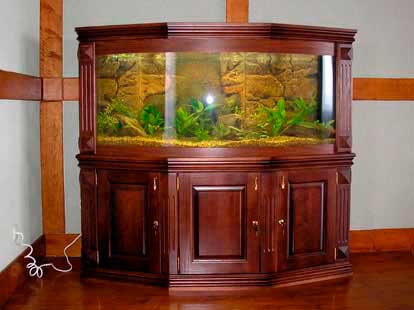
MDF is less susceptible to moisture damage thanks to its denser structure. This material costs more than particleboard but provides better moisture protection and more design flexibility. Solid wood treated with special moisture-absorbing compounds and anti-warping treatments leads in strength and allows placement of impressively large aquariums.
Metal Frame Construction
For aquariums over 125 gallons, it’s advisable to consider a stand with a metal frame. Such construction supports any weight and is impervious to moisture. If desired, the metal frame can be clad with decorative materials—wood, plastic, or particleboard panels to improve appearance.
Internal Organization and Functionality
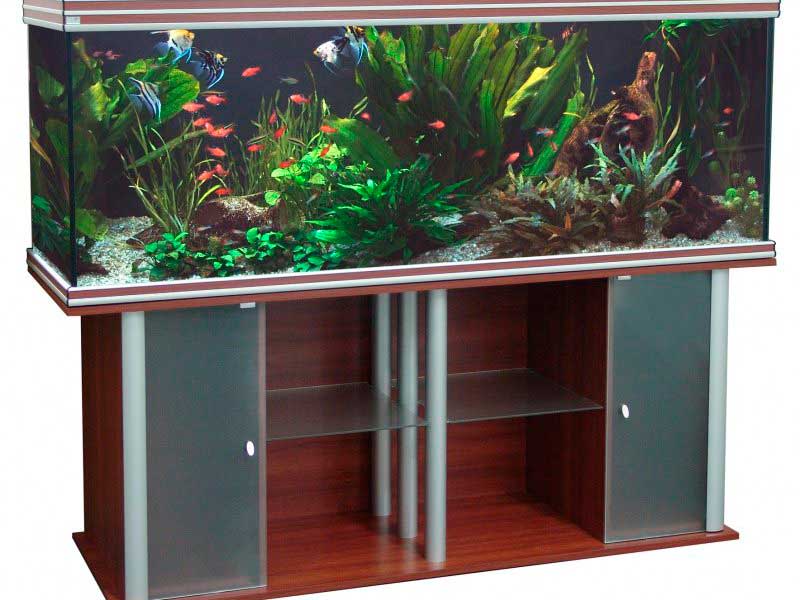
The stand should include multiple compartments and shelves for auxiliary equipment and supplies. If ordering a custom stand, you can specify the arrangement of compartments, shelves, and mounting points for filters, air pumps, and other equipment. This is especially important for marine setups, which often require complex filtration systems to maintain precise salinity levels.
Ideally, the back or one side panel should have an opening for electrical connections to pumps, heaters, and other equipment. The top of the stand should have another opening through which hoses, air lines, and sensor cables can reach the aquarium.
An important aspect is ventilation—equipment housed in the stand requires constant air circulation. Without adequate ventilation, moisture and heat from running equipment accumulate inside the stand, potentially warping materials and causing equipment failure.

Installation and Leveling
If your floor is uneven, equipping the stand with adjustable feet for leveling the top surface is worthwhile. However, you can manage without this feature. Since a stand is installed once for the long term, you can simply place wooden shims under the legs to ensure the stand doesn’t rock, sits stably, and has a perfectly level top surface.
In my experience, when installing a large aquarium, it’s better to position it near a load-bearing wall rather than in the center of a room—this reduces stress on the floor structure and improves overall stability.
Where to Purchase an Aquarium Stand
The acquisition question isn’t trivial. You can buy a ready-made stand from specialized retailers, choosing from available inventory. The selection is quite broad, and manufacturers’ production capabilities ensure the stand will be made from water-resistant materials or properly treated. The construction will definitely support the weight corresponding to the aquarium size for which it’s rated.
Both physical stores and online retailers offer catalogs of ready-made products where you can select a suitable stand in the needed color and size. Online selection is typically broader with better product information, though some physical stores have knowledgeable sales consultants who truly understand the subject.
Custom Fabrication
If ready-made products don’t fit your needs, you can order a stand built to custom specifications and dimensions. Just choose a reputable fabricator with experience in similar projects. Ideally, the workshop should be local so you can inspect the finished product before home delivery.
Since stands are built for aquariums of 75 gallons and up, that much water on your floor won’t bring joy—not to mention larger volumes. I won’t even mention the anguish over lost fish and conversations with downstairs neighbors if you live above the ground floor. Therefore, choosing a fabricator requires maximum responsibility.
Practical Maintenance Tips
Even a moisture-resistant stand requires proper care. After cleaning the aquarium, always wipe the top surface and sides completely dry. Don’t allow water to pool on surfaces—this can lead to gradual moisture penetration through micro-cracks in the protective coating.

Regularly inspect the condition of edges and ends—material deterioration most often begins there. If you discover peeling or damage to the protective layer, immediately treat problem areas with waterproof sealant or finish.
Conclusion
An aquarium stand fulfills multiple functions. Beyond its direct duty as a reliable tank support, it conceals all auxiliary equipment in its interior, improving the overall impression of your aquatic display. Now everything needed for aquarium maintenance can be hidden from view, giving your living space a more attractive, tidy appearance.
The variety of design solutions that can be realized in an aquarium stand can transform an entire room’s appearance. The key is remembering that beauty must combine with reliability—the safety of your entire aquarium system depends on the quality of its foundation.
Article updated: 2026-08-17