Introduction
The celestial eye goldfish, also known as stargazer or Cho-tengan, is a fancy goldfish variety with a distinctive short body. While Chinese vases depicting these remarkable fish reached Europe centuries ago, the variety itself became known to Europeans only in the early 20th century. This is one of the most unusual and demanding goldfish breeds, requiring special attention. Traditionally, Buddhist monks kept them in shallow temple pools.
Description
The celestial eye is considered a stable variety derived from telescope goldfish. It has a short, rounded body that can reach up to 15 centimeters in length. The body is egg-shaped with smooth contours along the back and head.
The defining feature of this variety is its eyes. The eyes are bulging, telescope-shaped, with pupils directed upward. According to Buddhist monk legend, this eye position allows the fish to gaze upon heaven itself—hence the name “celestial eye.” The alternative name “stargazer” is equally descriptive.
| Parameter | Value |
|---|---|
| Size | Up to 15 cm |
| Temperature | 18-22°C |
| pH | 6.5-8.0 |
| Hardness (dGH) | 6-18° |
| Tank Volume | From 100 L for a pair |
| Lifespan | 10-15 years |

Quality specimens should have symmetrical eyes of equal size with pupils pointing in the same direction. This variety must have absolutely no dorsal fin—even a small scar on the back significantly devalues the specimen. The tail should be spade-shaped and not exceed body length. Other fins should be as short and rounded as possible. Any deviation from these standards greatly reduces the fish’s value.
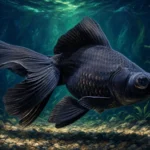
Orange, white, or orange-and-white specimens are considered more valuable. The rarest form is velvety black. Sexual maturity is reached at one year of age.
Sex Differences
Males differ from females as in other goldfish varieties: after reaching sexual maturity, males develop small whitish deposits on their gill covers resembling grains of semolina. Females are usually slightly fuller than males.
Care Requirements
The celestial eye is a goldfish breed far removed from its wild ancestor. The upward position of its eyes makes it impossible to properly view the sides or bottom. This creates feeding difficulties and makes this already clumsy creature even more vulnerable.
Tibetan monks keep this variety in ponds or pools. In temperate climates, they can be kept in greenhouse pools, but during winter they should either be heated or transferred to aquarium housing, as celestial eyes are prone to bacterial diseases at lower temperatures. For pond keeping, adequate protection from cats is essential.
They are best kept separately from other fish. This is not an easy species to maintain.
Tank Volume

A pair of adult fish requires approximately one hundred liters. With larger volumes, you can increase the number—a 200-liter tank can house 5-6 specimens.
Substrate
River sand or small, well-rounded gravel works best as substrate. Never use sharp-edged stones or driftwood with pointed branches—due to poor vision, fish may collide with them and damage their eyes.
Plants
Like all goldfish, celestial eyes appreciate planted areas. Along the back and side walls, you can create thickets of corkscrew vallisneria or Myriophyllum verticillatum. Canadian waterweed (Elodea canadensis) thrives in cool-water aquariums. You can also use Cryptocoryne wendtii, which tolerates cooler water well.
Water Parameters
Celestial eyes are more warmth-loving than other goldfish breeds but also struggle with heat. The optimal temperature range is 18-22°C. Water hardness is not critical—when using tap water, additional hardness adjustment is unnecessary. pH should be 6.5-8.0.
Lighting
Celestial eyes appreciate bright lighting and look their best under it. If kept in ponds or greenhouse pools during spring, summer, and fall, natural lighting suffices. During winter aquarium housing, provide supplemental lighting with fluorescent lamps totaling 0.5 watts per liter.
Aeration
Celestial eyes need high dissolved oxygen levels. If your tank is overstocked, continuous artificial aeration is essential around the clock.
Filtration
The same applies to filtration. Celestial eyes prefer clean water, so at minimum a mechanical filter for removing suspended particles is necessary. Biological filtration is also desirable. Without it, weekly water changes of one-third with fresh dechlorinated water are required. Stargazer eyes are susceptible to infections, so aquarium water must be crystal clear.
Compatibility
Compatibility with most fish is essentially nonexistent. These good-natured, clumsy creatures won’t harm anyone, but many peaceful aquarium residents can harm them. Even harmless fish like guppies can outcompete them for food due to their slowness. Aggressive species can damage their eyesight.
The best tankmates for celestial eyes are other slow-moving goldfish with similar characteristics—bubble eyes and certain telescope varieties. Avoid keeping them with fast breeds like comets or shubunkins.
If you decide to acquire such an unusual fish, you’ll need to work hard to create proper living conditions. Separate housing in this case is not a luxury but a necessity. Just as beginners need proper guidance when starting their aquarium journey, celestial eyes require dedicated attention to thrive.
Feeding
Live foods are preferred. Bloodworms, tubifex, and daphnia are consumed eagerly. Consider the stargazer’s vision limitations and offer bloodworms through a feeding ring so they don’t all fall to the bottom at once, giving your fish time to catch them.
Dry foods are also eaten willingly, though with less enthusiasm. However, in my experience, specialized goldfish foods are preferable to live foods, as goldfish are herbivores with long digestive tracts not designed to process large amounts of protein.
Plant matter supplements are essential. Chopped, blanched lettuce, cabbage, spinach, dandelion leaves, and oat flakes should comprise about one-quarter of the daily diet. Otherwise, when your hornwort is reduced to shreds, you’ll have only yourself to blame.
Feed goldfish 2-3 times daily in small portions, which suits their digestive system specifics.
Breeding
Breeding is straightforward and no different from other goldfish varieties. Sexual maturity occurs one year after hatching. A spawning tank of 80-100 liters with coarse river sand and fine-leaved plants is suitable. Place two males per female. Optimal spawning temperature is maintained at 22-26°C.
Fecundity ranges from 2,000 to 10,000 eggs. Larvae emerge after 2 days. On day 5, fry begin swimming. Start feeding fry with rotifers and infusoria.
The real challenge is producing celestial eyes meeting all breed standards—only about two per hundred achieve this. The rest have various defects that devalue them to varying degrees. Therefore, stargazers fully meeting breed requirements remain rare and expensive to this day.
Additionally, determining whether a specimen meets all requirements is only possible when it reaches one year of age.
FAQ
Can celestial eye goldfish be kept with other fish? Not recommended. Due to poor vision and slowness, they lose the competition for food even to peaceful species. Best kept separately or with other slow-moving goldfish.
What tank volume is needed for celestial eyes? Minimum 100 liters for a pair of adults. Add 40-50 liters for each additional fish.

What is the optimal water temperature? Optimal temperature is 18-22°C. Celestial eyes are more warmth-loving than regular goldfish and tolerate neither cold nor heat well.
What should I feed celestial eye goldfish? The diet should consist primarily of specialized goldfish foods and plant matter (about 25% of the diet). Offer live foods moderately due to digestive system specifics.
Why are celestial eye goldfish so expensive? Due to breeding difficulty—only 2 out of 100 specimens meet breed standards. Additionally, quality can only be assessed when fish reach one year of age.
Conclusion
The celestial eye, more than any other goldfish breed, requires constant attention and care. But if you master all the intricacies of caring for them, you can proudly say you own a true rarity. Despite being known to Europeans for over a century, this variety remains a curiosity not only here but in its homeland as well.
Article updated: 2026-11-09