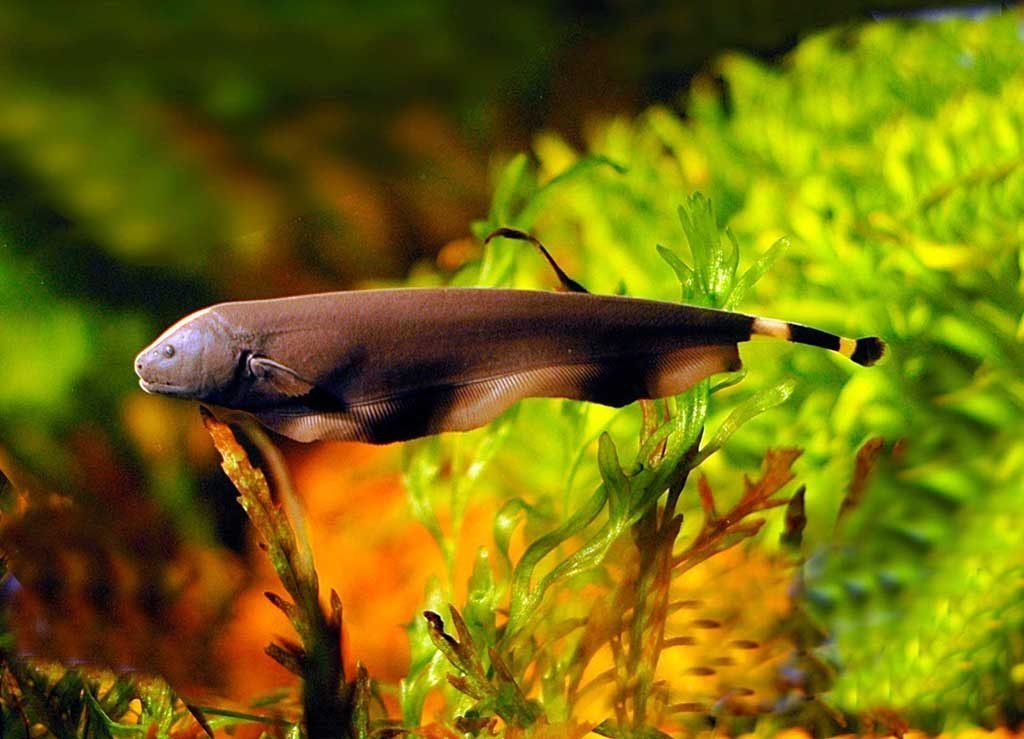
The Black Ghost Knifefish (Apteronotus albifrons) is one of the most unusual representatives of aquarium fauna, attracting attention with its unique body shape and graceful movements. This fish is also known as the black knife or black ghost knife. In my experience, keeping this species requires specific knowledge and preparation, but the result is worth it—watching these elegant creatures is a true pleasure.
Classification and Origin
Taxonomic position:
- Kingdom: Animalia
- Phylum: Chordata
- Class: Actinopterygii
- Order: Gymnotiformes
- Family: Apteronotidae
- Genus: Apteronotus
- Species: Apteronotus albifrons
The natural range covers the Amazon River basin and its tributaries in Brazil, Peru, Bolivia, Colombia, Ecuador, and Venezuela. In nature, these fish prefer dark, often murky waters of tributaries and streams with sandy bottoms. The Black Ghost Knifefish appeared in Russia in the early 1980s but remains relatively rare in hobbyist aquariums.
Description and Species Features
In nature, Apteronotus albifrons reaches lengths up to 50 cm; in aquarium conditions, the size typically does not exceed 30-40 cm. The body is strongly elongated, gradually tapering from the high front section toward the tail. The belly line is sharp, and the head is large. Coloration is blue-black or velvety black with characteristic white stripes—one runs along the upper part of the head, others are located at the base and on the tail.
A distinctive feature of the Black Ghost Knifefish is the absence of a dorsal fin and the presence of a long anal fin that extends from the throat to the very tip of the tail. Through wave-like movements of this fin, the fish moves and can even swim tail-first, which looks mesmerizing.
Electric Organ of the Black Ghost Knifefish
One of the most remarkable features of this species is the presence of a weak electric organ. The electric organ consists of two types of receptors: cone-shaped protrusions perceive electrical signals generated by the fish itself, while ampulla-like organs serve to detect low-frequency impulses from surrounding organisms. This organ generates a low-frequency electric field around the body, allowing the fish to navigate in space.

The electrical signals pose no danger to humans or other aquarium inhabitants. In my experience, this ability makes Black Ghost Knifefish particularly interesting to observe—they move confidently even in complete darkness, finding food and avoiding obstacles.
Black Ghost Knifefish Care Requirements
Tank Parameters
| Parameter | Value |
|---|---|
| Minimum volume | 150-200 liters per specimen |
| Water temperature | 23-28°C (73-82°F) |
| pH | 6.0-7.5 |
| Hardness (dH) | 5-15° |
| Lighting | Subdued |
| Filtration | Required |
| Aeration | Active |
| Water changes | 25-30% weekly |
Due to their large size (30-38 cm), a tank of 50-100 liters or more is necessary. I recommend acquiring a spacious aquarium right away—in cramped spaces, fish experience stress and may display aggression.
Tank Setup
The aquarium should have plenty of hiding spots—rocks and structures made from them, driftwood, caves. This is critically important since the Black Ghost Knifefish is nocturnal and prefers to hide during the day. The number of hiding places must be sufficient; otherwise, conflicts between fish are inevitable.
The bottom is best covered with coarse river sand. Vegetation should be dense—practically any species that tolerates the specified water parameters will work. Floating plants like Pistia, Riccia, and Limnobium are especially good, as well as large bushes with broad leaves—Nymphaea, Echinodorus, Cryptocoryne. Floating plants help create the subdued lighting these fish prefer.

Apteronotus albifrons is very sensitive to changes in water parameters. In my experience, stability of conditions is the key to successful keeping. Technical equipment for the aquarium should include a quality filter (preferably with peat filtration media) and a reliable air pump.
Feeding the Black Ghost Knifefish
The Black Ghost Knifefish is a micro-predator; in the aquarium, it accepts live and frozen foods: bloodworms, brine shrimp, shrimp, earthworms, tubifex, squid, and reluctantly takes dry foods. In nature, the main diet consists of various worms, insect larvae, small crustaceans, and fry of other fish.

In my experience, feeding is best done after lights-out or at dusk—this is when the fish are most active. Food should be varied and high-quality. The amount should be sufficient but not excessive. Given the predatory nature and large size of the fish, powerful filtration and regular water changes are necessary.
Compatibility with Other Fish
The Black Ghost Knifefish is a peaceful fish, suitable for a community tank with medium and large species, but small fish (guppies, neons) and invertebrates may be perceived as food. Toward their own kind, knife fish are quite aggressive, so it’s better to keep them individually.
Good tankmates include angelfish, large swordtails and mollies, rainbowfish, and peaceful catfish. I recommend avoiding active and lively species like barbs—they may disturb the shy Black Ghost Knifefish. Also avoid very small fish—neon tetras or other small characins risk becoming prey for this nocturnal predator.
Sexual Differences
Sexual differences are weak or absent; males are distinguished by a fatty hump on the nape, females are smaller and have a rounder belly line. A female can be identified by a rounded belly before spawning. There is a high-tech method of determining sex by the frequency of electrical impulses, but it’s inaccessible to most aquarists.
Breeding the Black Ghost Knifefish
Apteronotus albifrons reaches sexual maturity at 1.5 years. The breeding process is quite complex. Successful reproduction in home conditions is rare. Fish farms often use pituitary injections, but hobbyists must recreate natural conditions as accurately as possible.
Preparation for Spawning
In nature, during the rainy season, Black Ghost Knifefish migrate and water parameters change, so in the aquarium it’s necessary to simulate the rainy season. The best ratio of breeders is 2-3 males per one female.
To stimulate spawning, gradually reduce the water level in the tank over a month and raise the temperature by 2-3 degrees (simulating drought). Then begin the “rainy season”—over a month, gradually increase the water level by adding distilled water. It’s advisable to use a sprinkler system operating 3-4 hours daily.

An additional stimulus can be increased water flow in certain areas of the breeding tank, created with a pump or enhanced aeration. Before beginning the drought simulation, place large bushes of Pistia in the aquarium—fish will lay eggs in their roots.
Spawning and Raising Fry
Spawning usually occurs in the water flow during pre-dawn hours. One female can produce about 500 eggs. After spawning, breeders must be removed. Reduce the water level to 15 cm; aeration and lighting should be weak.
Add methylene blue and antibiotics to the water to prevent fungal infections. Monitor the eggs and promptly remove any that turn white. The incubation period is 1.5 to 4 days. At 28°C, larvae hatch in about two days, and after another 2.5-3 days, they transform into fry.
Despite their relatively large size, fry require fine zooplankton. By one month of age, they take on the coloration and shape of adult fish. At two months, juveniles may start fighting if the tank seems crowded or there aren’t enough hiding places.
Diseases and Prevention
Apteronotus albifrons prefers stable water parameters. In my experience, most health problems are related to sudden changes in conditions or poor water quality. By nature, this fish is timid and shows no aggression toward neighbors; it behaves especially uncertainly during relocation.
At the first signs of illness, it’s important to check water parameters and increase aeration. Standard aquarium medications are used for treatment, but dosage should be discussed with a specialist—scaleless fish may be more sensitive to medications.
Conclusion
The Black Ghost Knifefish is an interesting fish in all respects, requiring specific experience and patience. Keeping this species is more challenging than many popular aquarium fish, and breeding represents a true art. However, for genuine enthusiasts of exotic species, this may be only an additional incentive.
In my experience, observing the graceful movements of the black ghost, its unique ability to navigate using electrical impulses, and its nocturnal activity fully justifies the effort spent creating suitable conditions. If you’re ready to provide a spacious tank, stable water parameters, and varied live feeding, the Black Ghost Knifefish will become a true gem of your collection.
Article updated: 2026-09-21