Kerry Tetra: Description and Characteristics
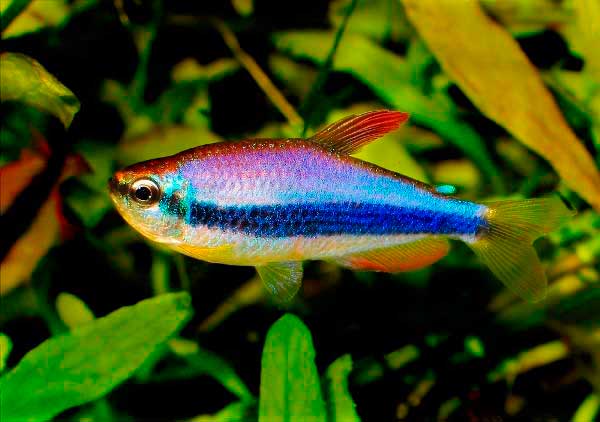
The Kerry tetra, also known as the purple emperor tetra (Inpaichthys kerri), is a small aquarium fish native to Brazil. It originates from the upper Madeira River basin—the largest tributary of the Amazon—inhabiting numerous streams and channels flowing through tropical forests. Thanks to its compact size, this species is perfectly suited for nano aquariums.
Small dimensions—up to 4-5 cm—and a torpedo-shaped body make this fish an ideal candidate for decorative aquariums. Males display intense violet coloration with a dark purple lateral stripe running along the body, a delicate cornflower-blue adipose fin, and all fins showing a subtle bluish tint. Females have a beige base color with a dark brown stripe and a brownish-red adipose fin.
This species is also commonly called the purple emperor tetra or false royal tetra. The scientific name is Inpaichthys kerri.
Kerry Tetra Care Parameters
Kerry tetras are peaceful schooling fish that should be kept in groups of at least 6-10 individuals. In my experience, a school of 8-10 specimens with an equal ratio of males to females feels most comfortable and displays natural behavior.
| Parameter | Value |
|---|---|
| Fish size | 4-5 cm |
| Minimum tank volume | 50-70 liters |
| Water temperature | 23-26°C |
| pH | 6.5-7.5 |
| Hardness (dH) | 4-16° |
| Keeping type | Schooling (6-10+ individuals) |
| Temperament | Peaceful |
| Lifespan | 3-4 years |

For keeping a school, you’ll need an aquarium of at least 60 liters, densely planted but with open swimming space. The bottom can be covered with any substrate: coarse river sand, small pebbles, or fine gravel work well. I recommend using dark substrate—Kerry tetras look most striking against it.
You can use any plants with compatible care requirements. Hornwort, elodea, vallisneria, some cryptocoryne species, and echinodorus varieties work excellently. Kerry tetras don’t damage plants, even the most delicate ones.
These fish are undemanding in care but sensitive to nitrate presence in water. Mandatory aeration, filtration, and weekly water changes are essential. In my experience, changing 20-25% of water weekly maintains optimal conditions.
Feeding
Kerry tetras have no special dietary requirements. You can feed them live, frozen, or dry foods. However, I recommend regularly providing live foods to maintain vibrant coloration and health.

They eagerly consume daphnia, cyclops, small bloodworms, and brine shrimp. You can also offer small portions of scraped lean beef. The fish prefer taking food from the water surface, which makes feeding particularly interesting to observe.
Kerry Tetra Compatibility with Other Species
You can keep a school of Kerry tetras in a community aquarium. Suitable tankmates include any peaceful fish of similar size and temperament, such as other peaceful characins. Ideally, they should be housed with other South American species, which may include small tetras like cardinal tetras, nannostomus species, hatchetfish, apistogramma or other dwarf cichlids, and peaceful bottom dwellers such as corydoras and otocinclus.
They also coexist well with small gouramis, rasboras, and peaceful barbs. In my experience, they get along excellently with danios and bettas, provided the latter don’t display aggression. No aggression toward other fish has been observed.
Breeding Kerry Tetras
Kerry tetras breed easily in aquariums. They reach sexual maturity at four months of age, but breeding should ideally begin when they’re at least six months old.
For spawning, it’s best to set up a separate aquarium. The breeding tank should measure at least 45×25×25 cm with a water level no higher than 15 cm, fine-leaved plant clusters, and weak, diffused lighting. For a single pair, you can use a breeding tank from 10 liters.
Water parameters: 26-28°C, dH 1-6°, pH 5.5-6.8, minimal carbonate hardness. Water hardness (GH) shouldn’t exceed 5°, otherwise males won’t be able to fertilize the eggs. Use soft water—rainwater or distilled water pre-filtered through activated carbon works well.
The bottom can be covered with sand, preferably with a protective mesh laid over it. Place a cluster of fine-leaved plants in the center, as the breeding pair will scatter eggs among vegetation. Fine-leaved plants like hornwort, Java moss, or ferns are preferable. You should also place several bunches of well-boiled willow roots in the corners.
Breeding can be conducted as group spawning (with equal numbers of males and females) or in pairs. Before spawning, feed the fish protein-rich foods, then separate females and males in pairs. Place fish in the breeding tank in the evening; tetras typically spawn the following morning.
A male will chase and may even kill a female not ready to spawn. A sign of female readiness is her restless circling around the aquarium. Egg-laying usually begins at dawn and can continue throughout the day. Males spread their fins and drive females toward plant clusters or willow roots, where they release small portions of eggs that males immediately fertilize.
Kerry tetra eggs are small, non-adhesive, light amber in color, and transparent. They’re usually difficult to spot in the aquarium. After spawning concludes, it’s advisable to remove the parents.
Raising Fry
Approximately twenty-four hours later, tiny fry emerge from the eggs. They lie motionless on the bottom, feeding on nutrients from their yolk sac. After about four days, they climb up the glass to the water surface, begin swimming actively, and start feeding.
By this time, you need to provide starter food—infusoria. After a couple of days, you can add cyclops or brine shrimp nauplii. As they grow, transition them to larger food types and transfer them to bigger containers, sorting by size.
Fry grow quickly and reach sexual maturity by six months of age. I recommend providing fry with varied nutrition from the first days—this ensures healthy development and vibrant coloration in the future.
Conclusion
Kerry tetras are suitable for beginning aquarists. This interesting and undemanding species looks magnificent in schools and coexists easily with other peaceful aquarium inhabitants. Their bright coloration and active behavior make them a welcome addition to both species-specific and community aquariums.
Article updated: 2026-08-23