Aphyosemion lamberti (Lambert’s killifish) is another fascinating member of the Aphyosemion genus that attracts aquarists with its unusual coloration and compact size. The species was described by Radda and Huber in 1977. This fish is small and doesn’t require a large aquarium. Its reproduction doesn’t need egg diapause, yet this species is far from easy to maintain. Let me explain everything in detail.
Natural Habitat
Aphyosemion lamberti inhabits the eastern part of Gabon in central Africa. In the wild, it’s found in streams and small rivers of forested areas and humid savannas. Water temperature in natural habitats ranges from 21.8-23.7°C, with conductivity of 24-57 µS, pH around 5, and hardness below 1.2° dGH. The aquatic biotopes of Lambert’s killifish are densely vegetated, providing shelter and serving as substrate for spawning.
Species Description
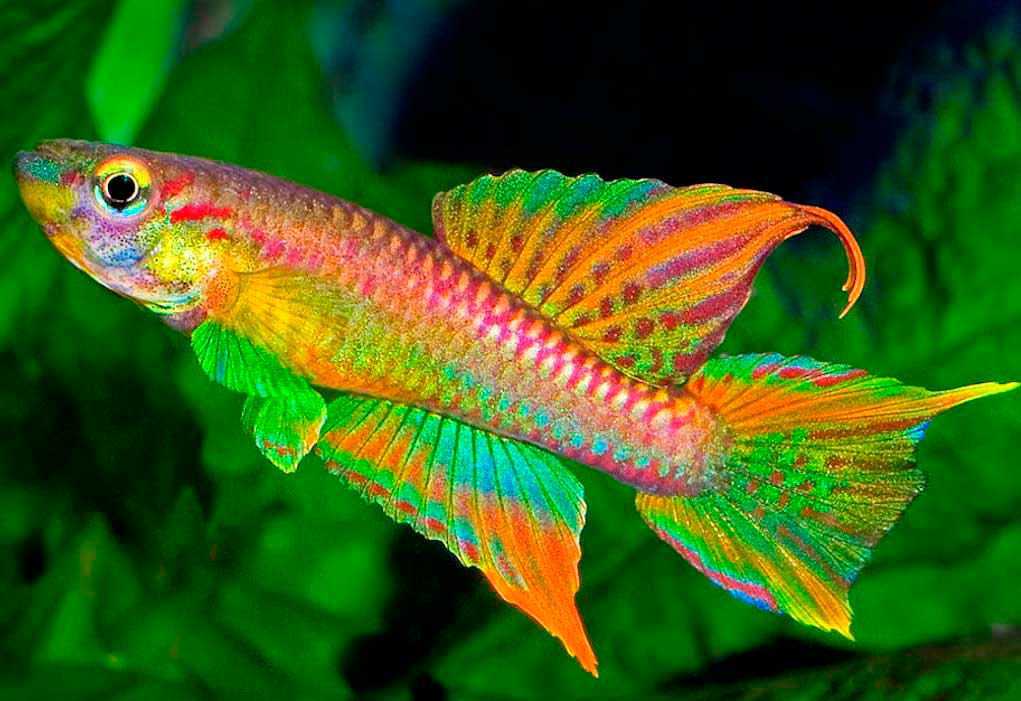
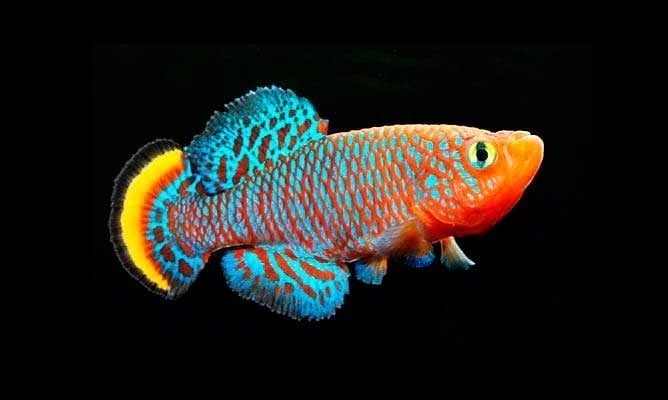
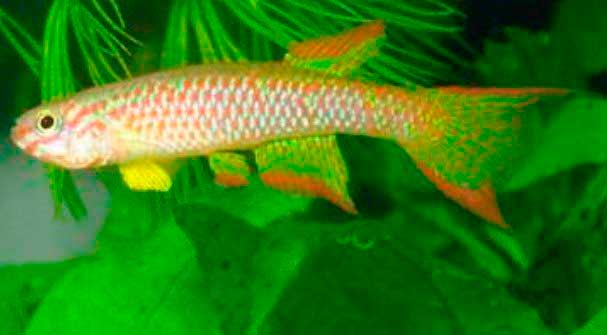
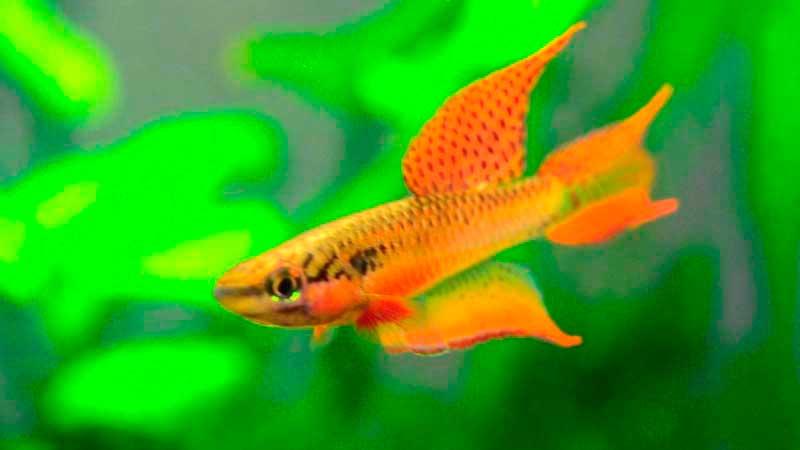
This is a small fish. Males reach a maximum of 5 centimeters in length, females about four. The predominant coloration is brownish-green, darker at the back and lighter toward the belly. Nevertheless, in reflected light rays, like most other aphyosemions, this fish shimmers with various shades of blue from turquoise to purple. All unpaired fins feature red lines, some interrupted, parallel to the rays (the so-called “flamboyant” pattern). Red dots or spots are unevenly scattered across the body. Along the back, these elements form a continuous line. Females look somewhat more modest than their mates but are equally charming.
| Parameter | Value |
|---|---|
| Scientific name | Aphyosemion lamberti |
| Family | Nothobranchiidae |
| Male size | up to 5 cm |
| Female size | up to 4 cm |
| Water temperature | 18-24°C |
| pH | 5.0-6.5 |
| Hardness | very soft (up to 2° dGH) |
| Minimum volume | from 20 liters |
Temperament and Compatibility
Lambert’s aphyosemion is peaceful, and no cannibalism has been observed. Males prefer peaceful coexistence over fights, which may indicate the beginnings of reason :-). Seriously though, this fish is truly very peaceful and beautiful. You can organize either a species-specific aquarium or a community tank with other killifish—they coexist very well. In my experience, a 20-30 liter tank is quite sufficient for a pair or trio of Aphyosemion lamberti. If you’re planning a compact setup, this fish makes an excellent choice for a small aquarium.
Feeding Aphyosemion lamberti
But here’s the catch: Aphyosemion lamberti is extremely picky about food. Don’t even show it bloodworms; tubifex doesn’t excite its appetite either. Live daphnia? Well, maybe if it climbed into their mouth by itself, but chasing after it isn’t a royal matter… Dry food? Oh, what am I saying? They look at live daphnia with contempt, let alone processed foods. It’s downright mockery.
What’s my point? In nature, killifish feed on small crustaceans, flying and aquatic insects, as well as insects that fall onto the water surface—for example, ants that happen to fall off grass blades while sunbathing. It’s extremely difficult to accustom wild-caught Aphyosemion lamberti to foods readily available in our regions. Catch local small insects for them? Well, that’s quite a viable option. What won’t you do for your favorite pet? But this is only possible in summer. What about winter? Breed mosquitoes at home? I doubt your other family members would appreciate that.
The Solution for Aquarium-Bred Specimens
There is one loophole for those determined to keep this fish. Fry obtained under artificial conditions are first fed infusoria, then transferred to Artemia nauplii. Most likely, individuals raised in aquarium glass will be better adapted to food types relatively available in our latitudes year-round. Dry food is probably still questionable, though if any readers have different observations and experience feeding Lambert’s killifish with, say, commercial pellets, I’d be grateful to hear about it.
Breeding Aphyosemion lamberti
Breeding A. lamberti is relatively straightforward. A spawning tank of three to five liters is suitable. The vessel bottom should be lined with fibrous peat. Water must be very soft and slightly acidic. After placing the breeders in the spawning tank, gradually increase temperature to 24-26°C. One male and several females can be placed for spawning. One female lays only a few eggs per day. Spawning lasts about a week, after which it’s better to remove the breeders.
At 26°C, eggs mature in approximately two to three weeks. Fry emerge with a large yolk sac that resorbs after about a day. By this time, you should already have infusoria ready to feed the fry for the first few days, then offer them Artemia nauplii. Remember that spawning is prolonged, so egg maturation and fry appearance won’t be instantaneous either.
Aquarium Setup and Care
For proper aquarium care of Aphyosemion lamberti, maintain very soft, acidic water conditions. Dense vegetation is essential, mimicking their natural habitat. Keep temperatures moderate—unlike tropical species such as Colisa labiosa, Lambert’s killifish prefers cooler water. The aquarium should have a tight-fitting lid, as killifish are excellent jumpers.
In conclusion, while Aphyosemion lamberti presents feeding challenges, particularly with wild-caught specimens, aquarium-bred individuals offer a more manageable option for dedicated hobbyists willing to provide the specialized care this beautiful species deserves.
Article updated: 2026-07-19