Introduction to Pygmy Corydoras
Corydoras pygmaeus, commonly known as the pygmy cory, is among the smallest members of the armored catfish family. First scientifically described by Knaack in 1966, this diminutive species quickly gained popularity among aquarists for its peaceful temperament and compact size. In my experience, the pygmy cory makes an excellent choice for nano aquariums and community tanks with other gentle species.
Unlike their larger cousins, these tiny catfish exhibit unique behaviors that set them apart. While most corydoras spend their time exclusively on the substrate, pygmy cories actively swim throughout the middle water column and frequently rest on broad plant leaves—a charming habit that adds visual interest to any aquarium.
Natural Habitat and Distribution
In the wild, pygmy cories inhabit the Madeira River basin, a major tributary of the Amazon in Brazil. They populate small streams, tributaries, and seasonally flooded forest areas, where they form large schools in shallow waters one to two meters deep. These fish prefer silty bottoms with slow-moving or still water, surrounded by dense aquatic vegetation and submerged tree roots.
Their natural environment features soft, acidic water stained with tannins from decaying organic matter. Groups of ten or more individuals constantly move together, displaying the strong social behavior characteristic of this species. Understanding these natural conditions helps recreate an optimal aquarium environment.
Physical Characteristics
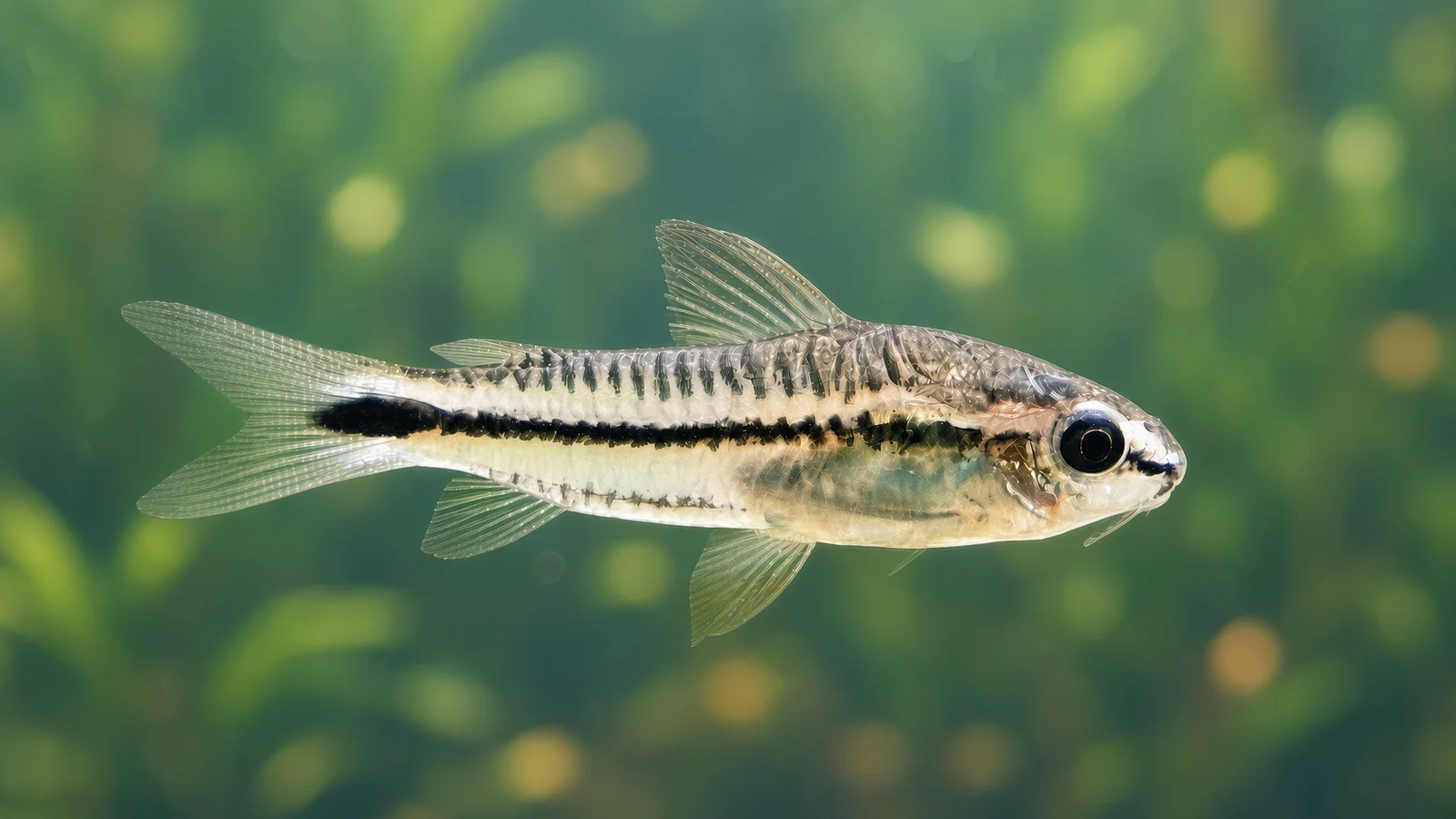
Adult females reach approximately 2.5-3 centimeters in length, while males remain smaller at around 2 centimeters. The body is elongated and slightly compressed, with a straight ventral line. Unlike larger corydoras species, pygmy cories have a much less pronounced hump on the head.
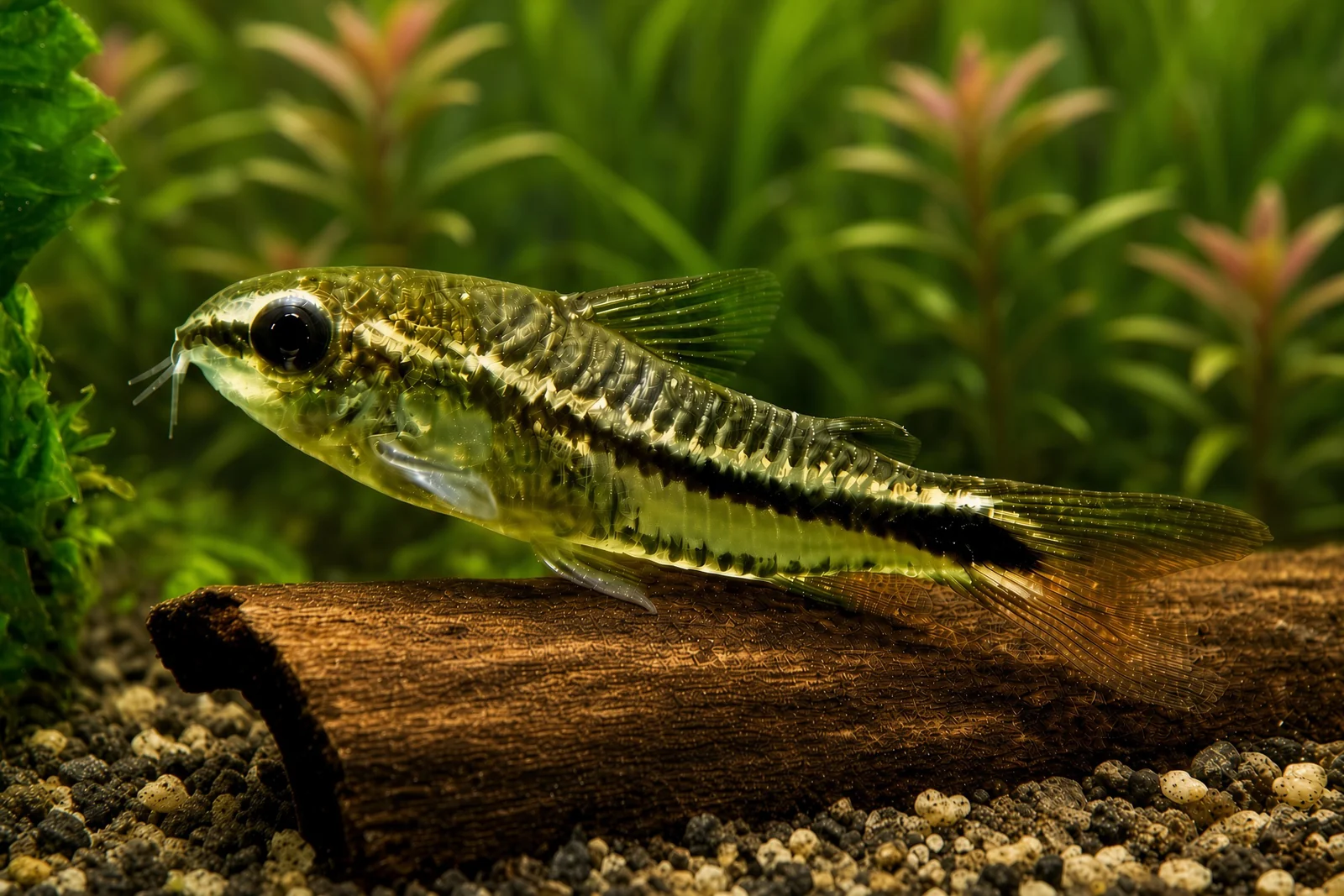
The body is covered with two rows of overlapping bony plates forming protective armor—hence the common name “armored catfish.” Coloration is silvery with a dark gray back. The most distinctive feature is a continuous black horizontal stripe running from head to tail along the lateral line, ending in a rounded dark spot. White stripes border this central marking above and below, creating striking contrast. All fins are transparent.
The caudal fin is forked, and like all corydoras, they possess an adipose fin. A sharp spine on the pectoral fin can be locked into position when threatened. The small mouth is surrounded by two pairs of sensitive barbels used for navigating murky water and locating food on the substrate.
Pygmy cories possess intestinal respiration—they periodically surface to gulp atmospheric air. This adaptation allows them to survive in oxygen-depleted waters, though proper aeration should always be provided in aquariums.
Pygmy Cory Tank Setup and Water Parameters
A group of 5-10 pygmy cories requires a minimum tank volume of 30-40 liters, calculating approximately 3 liters per fish. These are schooling fish that should never be kept individually—a minimum group of five is essential, though ten or more is optimal for natural behavior and reduced stress.
Optimal water temperature ranges from 22-26°C (72-79°F), with pH between 6.0-8.0 and hardness from 2-20 dGH. Weekly water changes of 25-33% are necessary, along with reliable filtration and aeration. Despite their intestinal breathing capability, dissolved oxygen should remain adequate.
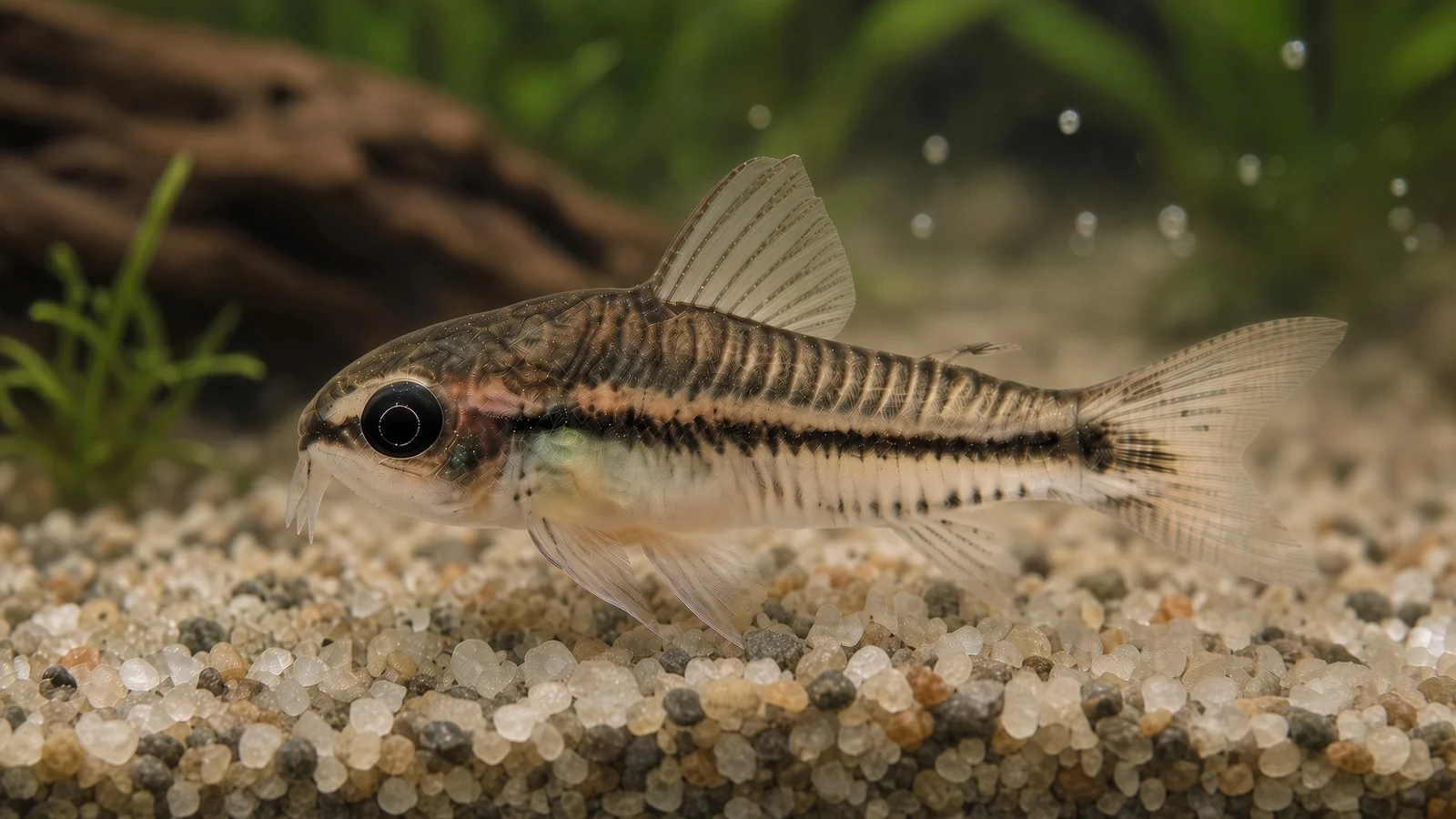
Substrate selection is critical. Use soft sand or smooth, rounded fine gravel to prevent damage to their delicate barbels. Dark-colored substrate enhances their natural coloration. Provide hiding spots through driftwood, caves, and rock formations. Plant the perimeter densely while leaving open swimming space in the center. Subdued, diffused lighting works best.
These fish are naturally timid and will dart into vegetation when startled by sudden movements near the tank. In larger volumes with sufficient cover, this skittishness diminishes. With proper care, pygmy cories typically live 3-4 years in captivity.
Compatible Tankmates and Feeding
The peaceful nature of pygmy cories makes them ideal for community aquariums with other small, non-aggressive species. Excellent companions include rasboras, neon tetras, other small tetras, dwarf rainbowfish, guppies, platies, and dwarf cichlids like apistogrammas. They also coexist well with freshwater shrimp such as cherry shrimp and crystal shrimp.
Avoid housing them with large or aggressive fish that might prey on them or cause stress. For instance, pairing them with large goldfish or aggressive bettas would be inappropriate.
In nature, these fish consume zooplankton, phytoplankton, detritus, insect larvae, worms, and tiny crustaceans. In aquariums, they accept live, frozen, and quality dry foods. Due to their small mouths, all food must be appropriately sized—cyclops, microworms, small bloodworms, daphnia, baby brine shrimp, and sinking micro-pellets or tablets designed for small catfish. Larger foods like standard bloodworms should be chopped.
Vegetable matter can be offered occasionally—blanched lettuce or dandelion leaves work well. They primarily feed from the substrate and plant leaves but will rise to the surface for food. Feed small amounts 2-3 times daily rather than one large feeding.
Breeding Pygmy Corydoras
Sexing pygmy cories requires close observation. Females are noticeably larger with rounder, fuller bellies when viewed from above. The dorsal fin tip is rounded in females but pointed in males. Sexual maturity occurs at 7-10 months of age.
When maintained in groups of twelve or more without other species, pygmy cories may spawn spontaneously in the main aquarium without intervention. However, for controlled breeding, set up a dedicated spawning tank of at least 10 liters. Stock it with 1-2 females and 3-5 males, though pair spawning is also possible.
Spawning tank parameters: temperature 24-25°C, hardness up to 6 dGH, pH 6.5. Darken most of the tank, leaving one well-lit wall. Trigger spawning through daily water changes with slightly cooler water, dropping temperature by 2-3 degrees, and increased aeration. Note that pygmy cories are more challenging to spawn on a schedule compared to larger corydoras—they breed when naturally ready.
Females deposit 30-100 adhesive eggs on glass or plant leaves. Remove adults after spawning or transfer eggs to a separate incubation container. While pygmy cories don’t always consume their own eggs, removal ensures better survival rates. Add methylene blue to prevent fungal infection.
At 24-26°C, eggs hatch in 3-4 days. Initial fry foods include infusoria, rotifers, newly hatched brine shrimp nauplii, and finely powdered egg yolk.
Practical Care Tips
I recommend that aquarists pay attention to several key points. First, never keep pygmy cories alone—as schooling fish, they experience significant stress in isolation. Second, regularly inspect their barbels; if they begin shortening or breaking off, the substrate may be too rough or water quality insufficient.
Monitor behavior closely. Healthy pygmy cories actively explore the aquarium, rest on leaves, and periodically surface for air. If they constantly hide, refuse food, or remain near the surface gasping, investigate water quality immediately.
When introducing new fish, always quarantine them for two weeks to prevent disease transmission to established inhabitants. Raising quarantine tank temperature by a couple degrees can accelerate the manifestation of potential illnesses.
The pygmy cory represents an outstanding choice for aquarists seeking a small yet dynamic and engaging aquarium. These miniature catfish are hardy, peaceful, and with appropriate care will provide years of enjoyment through their active, social behavior.