Why and How to Change Aquarium Water Correctly
An aquarium is a miniature living ecosystem, and water is its foundation. Watching fish glide through the tank is wonderfully relaxing, but behind that beauty lies the dedicated work of a responsible owner. One of the most important maintenance tasks is regular water changes. At first glance it may seem tedious, but a few simple rules turn it into a quick and satisfying routine.
First, let’s understand why regular water changes matter so much. As fish and other inhabitants go about their lives, ammonia, nitrites, and nitrates accumulate in the water as organic waste breaks down. Even with a high-quality filter running, the concentration of these compounds gradually rises. When they exceed safe levels, fish immunity drops, diseases appear, and inhabitants begin to die. Regular partial water changes are the most reliable way to keep water chemistry within safe boundaries. You can learn more about maintaining a healthy tank environment in our guide on maintaining aquarium life.
Core Rules for Freshwater Aquarium Water Changes
Frequency and volume. The golden rule of fishkeeping: change 20–30% of the water weekly. This approach maintains a stable microflora without destroying the established biological balance. A complete water change is only justified in emergencies — severe algae blooms, pathogen outbreaks, or acute water poisoning. In all other situations a full change does more harm than good: it wipes out the colony of beneficial nitrifying bacteria living in the substrate and biological filter.
Preparing tap water. Tap water contains chlorine, chloramines, and heavy metals — all toxic to fish. The classic neutralisation method is letting water stand in an open container for 48–72 hours: chlorine evaporates and suspended particles settle. For large tanks (200 litres and above) it is practical to keep one or two 50–100 litre plastic containers always at the ready. A faster and more reliable method is using a dechlorinating water conditioner (e.g., Tetra AquaSafe, Sera Aquatan): these instantly neutralise chlorine and bind heavy metals. From the editorial team’s personal experience, combining 24 hours of settling with a conditioner gives the best results.
Temperature matching. New water must match the aquarium temperature within ±1–2 °C. A sharp temperature drop causes thermal shock and weakens the immune system. Always verify the temperature with a thermometer — not by hand.
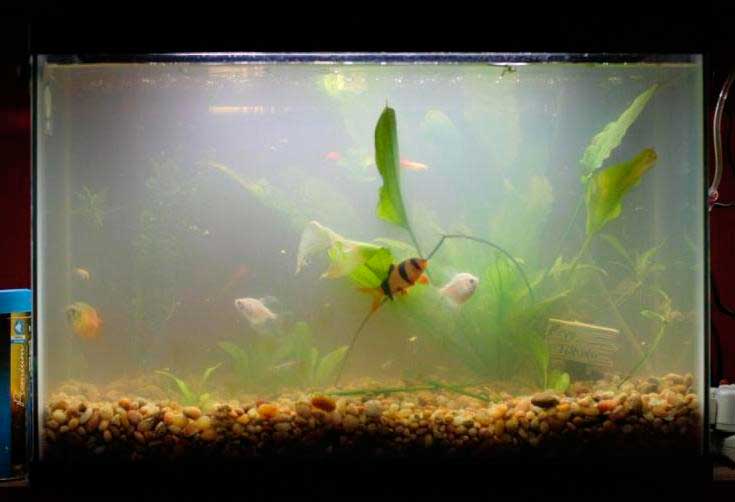
Substrate vacuuming. Combine water changes with gravel cleaning: use an aquarium siphon to remove organic debris from the substrate. This further reduces nitrate build-up. If you notice the water turning cloudy after a change, consult our article on why aquarium water turns cloudy for possible causes and solutions.
Filter and décor care. Before adding new water, clean the inner glass with a soft scraper and check the filter. Rinse the filter media only in the water removed from the tank — never in tap water — to preserve the beneficial bacterial colonies.
Water Parameter Table for Freshwater Aquariums
| Parameter | Optimal Value | Acceptable Range |
|---|---|---|
| Temperature | 24–26 °C | 18–30 °C (species-dependent) |
| pH | 6.8–7.5 | 6.0–8.5 |
| Hardness (GH) | 8–12 °dH | 4–20 °dH |
| Ammonia (NH₃) | 0 mg/L | < 0.02 mg/L |
| Nitrite (NO₂) | 0 mg/L | < 0.1 mg/L |
| Nitrate (NO₃) | < 20 mg/L | < 40 mg/L |
| Chlorine | 0 mg/L | 0 mg/L |
For detailed information on pH control, see our dedicated article on aquarium water pH.
These values apply to the majority of popular species — from hardy mollies (Poecilia sphenops) such as the Snowflake Molly to the more demanding Siamese Fighting Fish (Betta splendens).
How to Change Water in a Marine Aquarium: Key Differences
A marine aquarium demands a more meticulous approach. Ordinary tap water is not an option — use reverse-osmosis (RO) or distilled water mixed with a dedicated marine salt mix (e.g., Red Sea Salt, Aquaforest Salt). Dissolve the salt in advance, bringing the specific gravity (salinity) to 1.023–1.025 g/cm³ and matching the temperature of the display tank.
Marine water change frequency: 10–15% of the volume weekly, or 20–25% every two weeks. Stability matters more than frequency: sudden fluctuations in salinity and pH are dangerous for corals and invertebrates.
Mandatory parameter testing. Before each water change, measure pH, salinity, calcium, and magnesium levels. Marine chemistry is considerably more complex than freshwater, and neglecting tests leads to rapid livestock losses.
Step-by-Step Water Change Guide
- Prepare settled or conditioned water at the correct temperature.
- Switch off the heater and filter (to prevent them running dry at low water level).
- Use a gravel siphon to remove organic debris from the substrate while draining 20–30% of the water.
- Clean the inner glass with a scraper or soft sponge.
- Add the prepared water slowly — pouring over a plate prevents disturbing the substrate.
- Switch the filter and heater back on.
- Log the date of the change to keep your schedule consistent.
FAQ: Common Questions About Aquarium Water Changes
❓ How often should I change aquarium water?
For most freshwater aquariums, once a week replacing 20–30% of the volume is ideal. In heavily planted tanks (Dutch or nature-style) every 10–14 days is acceptable, provided you test nitrate levels regularly.
❓ Can I use tap water directly?
No. Tap water contains chlorine and chloramines that are toxic to fish and beneficial bacteria. Always let it stand for at least 24–48 hours or treat it with a dechlorinator before adding it to the tank.
❓ Why are my fish acting stressed after a water change?
The most common cause is a sharp temperature or pH difference. Make sure the new water matches the aquarium in both temperature and chemistry. If the problem recurs, test your water parameters with a test kit.
❓ Do I still need water changes if I have a powerful filter?
Yes. A filter converts ammonia and nitrites, but nitrates still accumulate steadily. The only reliable way to reduce them is regular water changes. A filter and water changes work together — neither replaces the other.
❓ How do I handle water changes in a very large aquarium?
Invest in a dedicated storage container (50–150 litres) for pre-conditioning water. A submersible pump or Python-style water changer makes draining and refilling much faster and less messy.
Sources:
– FishBase — biological data on aquarium fish species: fishbase.org
– Aquatic Community practical fishkeeping guides: aquaticcommunity.com
– Association of Zoos and Aquariums (AZA) water quality recommendations: aza.org
Last updated: July 06, 2026